

Hey all, Jason here.
Happy Labor Day weekend to my American readers. Hopefully you’re enjoying the long weekend, which traditionally marks the informal end of summer. Summer definitely feels like it’s already been over for a couple weeks here in the Netherlands, with a return of the frequently grey, drizzly, and windy weather the country is known for.
Things To Know & Other Good Reads
Joint Statement on Suspicious Activity Report Confidentiality Considerations Regarding Communications with Customers (FDIC/Interagency)
Impacts of Certain CFPB Workforce and Contract Actions on Agency Operations (FRB Office of Inspector General)
Digital Asset Investment Scams: 2023-2025 Threat Pattern & Trend Information (FinCEN)
Revolut Bank US, National Association, Conditional Charter Approval (OCC)
OpenReserve Bank, National Association, Conditional Charter Approval (OCC)
House Financial Services Committee Unveils CFPB Reform Package (Congressman French Hill)
Are Central Banks Moving Out of Dollar Assets? (Liberty Street Economics/New York Fed)
Ninth Circuit Ruling Casts Uncertainty Over Prediction Markets for Sports Event Contracts (Manatt)
Borrowing Isn’t the Bond Market’s Only Concern—Growth Is Too (Wall Street Journal)
The Trump Administration’s Plan for Protecting Consumers? Politely Ask Companies to Behave. (ProPublica)
Hyperscale Normalization (Ed Zitron)
FIS Launches Embedded Banking Platform, Letting Banks Deliver Accounts and Payments Inside Business Software (FIS)
Listen: Cash Flow Conversations Ep 7: A Traveling Credit Score (Fintech Takes x Nova Credit)
Listen: Adam Posen Thinks Things Could Get Very ‘Messy’ for the Fed (Odd Lots)
Homeland Security, Tether Illegally Seized Stablecoins, Two Legal Filings Allege
Tether, issuer of USDT, improperly froze more than $42 million worth of the most commonly used stablecoin at the informal request of Homeland Security Investigations, two Bangkok-based men argue in multiple recent legal filings.
The matter gained widespread attention in the crypto world last week, following a lawsuit filed by the two men, Nutthawat “David” Rukthammachalern and Natthawat “Peter” Kasamvilas, against four of Tether’s El Salvador-based legal entities. (The case first came to my attention via a tweet from Ariel Givner, and the basics have been widely covered in crypto-focused trade press.)
But the lawsuit, filed on September 1st in federal court in the Southern District of New York, follows a separate July 31st motion the two filed in North Carolina, asking the court to compel the U.S. Government to return the 42,417,785.62 USDT in question.
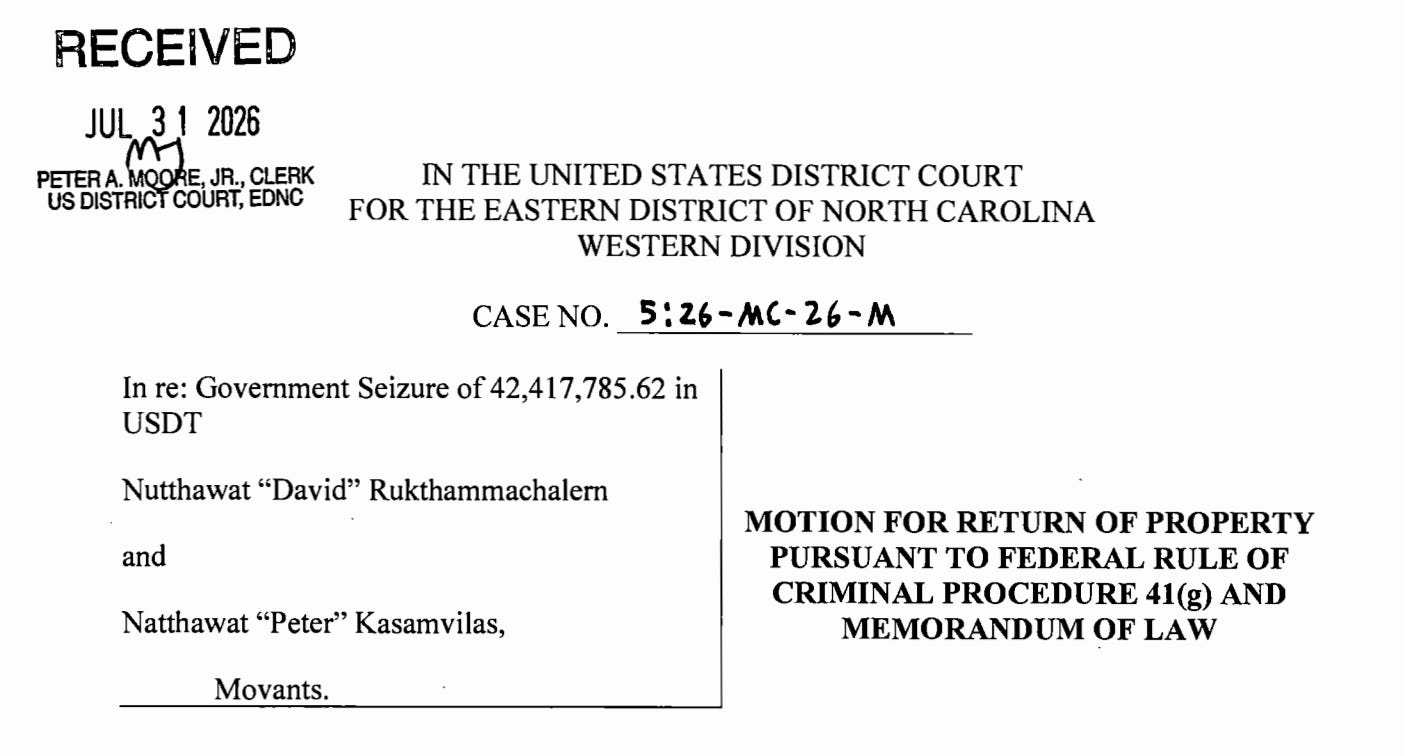
Rukthammachalern’s and Kasamvilas’ also filed a copy of the original Affidavit and Warrant to Seize Property Subject to Forfeiture in support of their motion, though that document and the original case it is associated with, Case No. 5:26-MJ1267-JG, remain under seal.
However, in their motion asking the court to submit that affidavit under seal, Rukthammachalern and Kasamvilas provide further context on the Department of Justice action associated with the asset freeze, linking to a press release issued by the U.S. Attorney’s Office for the Eastern District of North Carolina.
According to that press release, the approximately $42 million Rukthammachalern and Kasamvilas are seeking was part of a larger seizure of $61 million worth of USDT, which the statement describes as “allegedly associated with the laundering of criminally derived proceeds stolen from victims of cryptocurrency investment scams, commonly known as a ‘pig butchering scheme.’”
While the press release doesn’t specifically name Rukthammachalern and Kasamvilas, it says that “criminal actors targeted and recruited victims by establishing trust under the pretense of a romantic relationship,” and then lured victims with the promise of earning substantial returns through crypto investments into depositing funds into fake cryptocurrency trading platforms.
After receiving a tip from a victim in North Carolina to the Homeland Security Investigations (HSI) tip line of alleged investment fraud, the news release says, agents traced the victim’s money through multiple crypto wallets, several of which still contained substantial amounts of funds, and worked to freeze those funds.
The release specifically acknowledges Tether’s cooperation, saying, “The Department of Justice and HSI acknowledges Tether for its assistance in transferring these assets.”
But, in the motion asking for the release of their funds and in their lawsuit against Tether, Rukthammachalern and Kasamvilas categorically deny the funds have any illicit provenance.
In the North Carolina motion asking the court to order the U.S. Government to return the funds, the two note that “[t]he Government has not filed an indictment or instituted any criminal proceedings against [them], nor has it commenced civil forfeiture proceedings or identified any lawful basis for continuing to hold the assets.”
While the U.S. Attorney’s press release claims the funds are the result of a pig butchering romance scam, Rukthammachalern and Kasamvilas say in their motion that they operate “a legitimate authorized gaming promotion business.” The two work with an unnamed U.S.-listed company that operates licensed casinos in Asia, according to their motion.
The funds in question are related to “VIP gaming experiences,” including transportation, food, and lodging for VIP customers at the unnamed company’s licensed casinos, the two say. Additionally, the company conducts KYC/AML screening on authorizing gaming promoters, including Rukthammachalern and Kasamvilas, and on the VIP customers. Rukthammachalern and Kasamvilas relied on the screening conducted by the gaming company, they say, and independently screened customers’ USDT wallet addresses using commercially available tools.
While HSI obtained a seizure warrant for 15 crypto wallets holding the $42 million worth of USDT on February 19, 2026, pursuant to the still-sealed affidavit, the funds had actually been frozen earlier, on or around October 25, 2025, despite the lack of a warrant or legitimate legal justification, Rukthammachalern and Kasamvilas argue in their motion.
Per the public motion, the sealed HSI affidavit alleges that Tether froze the funds at law enforcement’s request, despite the lack of a specific legal basis to do so.
“The Government’s actions with Tether effectively seized the funds nearly four months before the Government obtained a seizure warrant. Thus, as of October 25, 2025, the Government effected a warrantless seizure of Movants’ funds working through Tether as its instrument,” the motion argues.
While the USDT in question had been obtained on the “secondary market,” meaning through transactions with other users or exchanges, rather than directly from Tether, Kasamvilas contacted Tether to inquire about the freeze. Tether referred him to the Department of Homeland Security, the motion says, and provided the email address of a specific HSI agent.
Even the seizure warrant that was ultimately filed, approximately four months after the funds were frozen, fails to establish probably cause, Rukthammachalern and Kasamvilas argue.
The seizure warrant itself remains sealed, but Rukthammachalern’s and Kasamvilas’ motion reveals some of the underlying allegations in its argument that HSI failed to establish probable cause:
“As to the first flaw, the Affidavit identifies one North Carolina victim-"GM"-whose approximately $30,000 loss was traced to a "known scam consolidation wallet." GM is the only victim whose specific transfers and amounts the Affidavit identifies. (Aff. 1137--49.) The affiant then "back-traced" from the "known scam consolidation wallet" and identified 18 wallets belonging to Thai nationals. (Aff. 1153-55.) From there, the affiant traced forward from those 18 wallets to 11 other wallets that received transfers from two Thai nationals, denoted as PM and WJ. (Aff. 1157-58.) Critically, none of those 11 wallets belong to Movants, and the Affidavit alleges no tracing from the "known scam consolidation wallet" to PM, from the "known scam consolidation wallet" to Movants' wallets, or from the NC victim (GM) to Movants' wallets. The Affidavit simply does not allege facts that connect NC victim funds to Movants.”
The motion further argues that the exhibits attached to HSI’s sealed warrant that purport to show these links are “so blurry and illegible that it is impossible to meaningfully review or decipher the purported ‘tracing’ the Government relies upon to support its seizure,” and that when more legible copies of these documents were requested, “the Government produced images in which key portions of the graphs remained unreadable.”
A second line of argument in HSI’s sealed warrant attempting to link Rukthammachalern’s and Kasamvilas’ wallets to allegedly illicit funds would have been “objectively impossible,” their motion argues (emphasis in the original).
Rukthammachalern and Kasamvilas actually met in person with HSI officials on May 21, 2026, according to their motion.
During that meeting, they “asserted their claims to these addresses through counsel and presented evidence… demonstrating the lack of tracing in the Government's affidavit and the lack of probable cause for the seizure. Despite [their] proactive efforts, the Government provided no substantive answers and no path for [them] to challenge the over nine-month long and continuing seizure.”
Fintech Business Weekly is made possible by the generous support of paying subscribers — bringing you independent analysis of banking, fintech, and crypto without fear or favor.
You can support my work by becoming a paying subscriber if you aren’t already. Paying subscribers enjoy:
access to the entire archive of nearly six years of newsletters
extended versions of the weekly newsletter, with additional content and analysis
and (for founding member tier) quarterly personal 1:1 fintech Q&A / strategy calls with me, tapping into my unparalleled knowledge of the intersection of banking and fintech and experience working in the sector, including helping to launch Goldman Sachs’ retail bank Marcus
You can also support Fintech Business Weekly by sponsoring a newsletter or podcast, putting you in front of 93,000+ of the most influential decision makers in banking, fintech, and crypto. Learn more about sponsor opportunities or request a media kit by dropping me an email.
Does Tether Have Legal Authority To Freeze Tokens?
In the separate lawsuit filed against Tether in the Southern District of New York last Tuesday, Rukthammachalern and Kasamvilas pursue a distinctly different legal strategy.
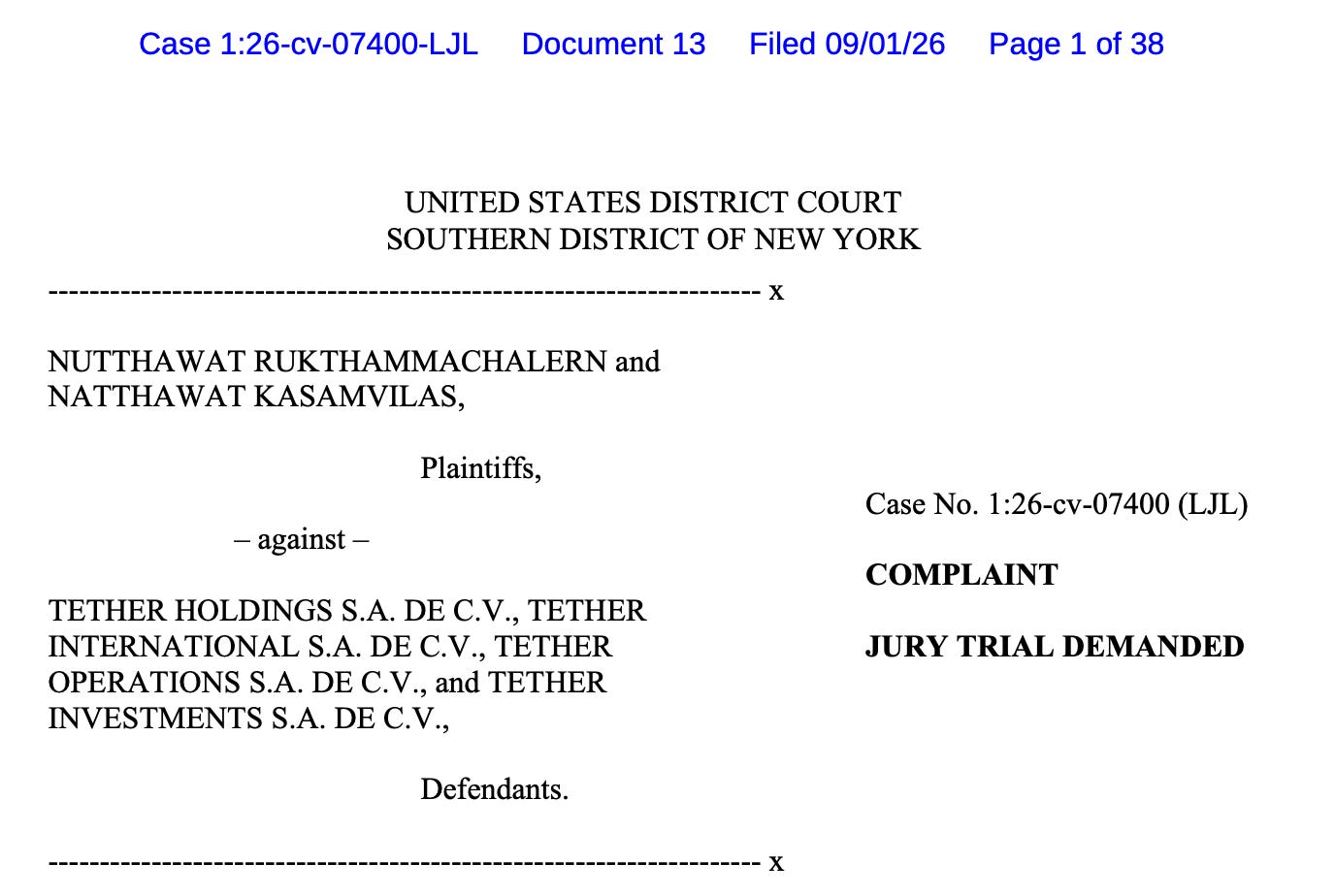
Their case against Tether, the original issuer of the frozen USDT, turns in part on the question of whether or not Tether, even when presented with a valid warrant, has the legal right to freeze or destroy assets that do not belong to it and are not in its custody.
One of the frequently touted benefits of cryptocurrencies, including stablecoins like USDT, is the ability to “self-custody,” meaning to hold possession of an asset — in this case, the “private keys” associated with the $42 million of USDT — rather than relying on a trusted third-party to hold an asset for you.
In contrast, a bank deposit, the basic functionality of which stablecoins like USDT seek to mimic, are definitionally liabilities of the bank. Stablecoins are often thought of and described as a digital version of physical cash, a bearer instrument that needs no custodian.
But while Tether doesn’t act as a custodian of USDT circulating in the secondary market, the “smart contracts” on which USDT operates enable Tether to unilaterally freeze or destroy tokens held in wallets, as allegedly happened to Rukthammachalern and Kasamvilas.
Rukthammachalern’s and Kasamvilas’ complaint argues that they own the respective wallets in question, that the USDT in question is their property under New York law, that the funds were not held in custody by Tether, and that they had no contractual relationship with Tether, as they obtained the USDT in question on the secondary market.
Their complaint alleges that Tether froze the USDT in question “based on an informal request by the U.S. government, acting through the HSI Agent, voluntarily and without legal obligation or authority, and to date have maintained that freeze.”
The HSI seizure warrant, obtained on February 19, 2026 — months after Tether had already frozen the USDT — explains that Tether could effectuate such a freeze and transfer by “burning” (destroying) the USDT associated with Rukthammachalern’s and Kasamvilas’ wallets and reissuing new USDT to wallets controlled by the US Government.
But even if HSI had obtained a seizure warrant in a timely manner, Tether had no legal right to freeze or destroy the USDT in question, the complaint argues, as Tether “do[es] not have legal possession, custody or control over [Rukthammachalern’s and Kasamvilas’] USDT in the Addresses and gained no legal authority to take action over [Rukthammachalern’s and Kasamvilas’] USDT as a result of the warrant.”
While Tether “may possess a technological capability to interfere with USDT held by strangers; they had no legal right to exercise that capability as to [Rukthammachalern’s and Kasamvilas’] USDT,” the complaint says.
Rukthammachalern and Kasamvilas are seeking a declaratory judgment that they are the right and lawful owners of the USDT in question and that Tether’s freeze of the funds was unlawful and to enjoin Tether from further freezing or destroying the funds, absent a final and valid order of a court of competent jurisdiction, or of a federal agency acting pursuant to its statutory authority.
Masive IDScan.net Hack Compromises 153 Million Credentials
Last week, it came to light that 153 million identity credentials were compromised and appear to be for sale in an apparent hack of the ID verification firm IDScan.net, security researcher Brian Krebs of KrebsOnSecurity revealed last week. Jack Henry, which is an IDScan.net client, concurrently disclosed a cyber incident, though it is unclear if the two are connected.
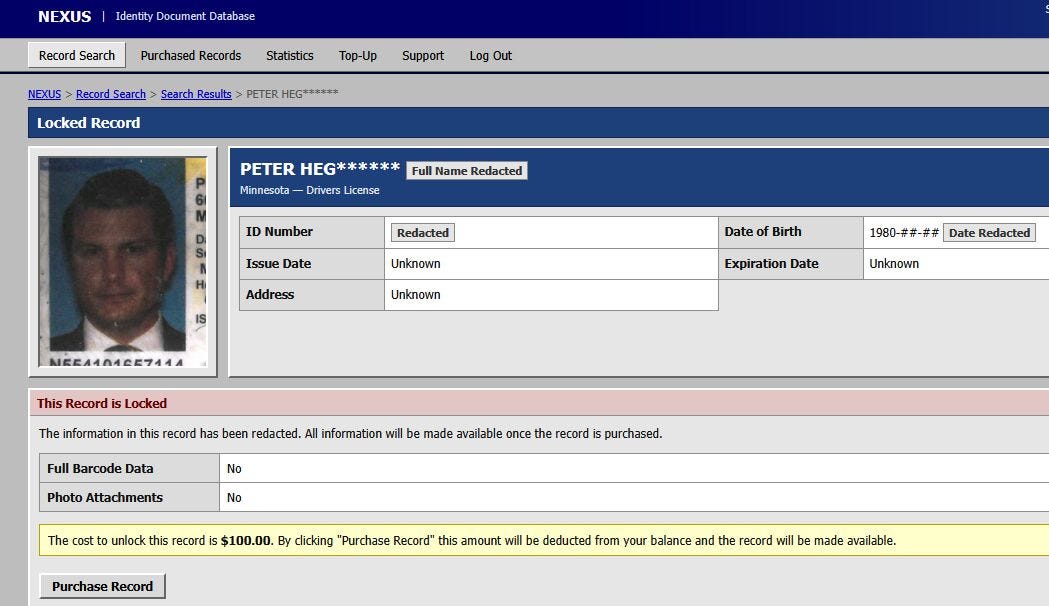
Some of the credentials available via the service include infrared and ultraviolet image scans, commonly captured by in-person device readers at merchants like car rental locations, marijuana dispensaries, and nightclubs.
The people behind the service selling the credentials, dubbed Nexus, described the documents as coming from an “ongoing breach” at “a major identity verification company,” according to Krebs. The FBI has reportedly launched an investigation into the hack.
According to IDScan.net’s website, it provides services that include ID scanning, ID authentication, mobile drivers license reading, and deepfake fraud prevention for both in-person and mobile/online use cases.
While less well known in the fintech and banking world, the services are roughly comparable to those provided by fintechs like Socure, Alloy, Persona, and Jumio.
Known clients of IDScan.net include the U.S. Coast Guard, rental car company Hertz, Target, Caesars Entertainment, and FedEx, as well as financial services companies like LendingUSA, Simmons Bank, Paragon Bank — and core bank provider Jack Henry.
The news of the alleged IDScan.net hack broke publicly on September 1st.
The day prior, Jack Henry publicly disclosed a “cyber security incident,” saying in a brief news release, “Jack Henry recently detected a cybersecurity incident within a limited portion of our internal, non-production corporate environment. No client-facing systems, operating systems, core platforms, or daily processing services were accessed or disrupted, and they all remain secure and fully operational. We did not experience any system outages.”
It is not immediately clear if Jack Henry's announcement is related to IDScan.net.
Jack Henry’s announcement added, “Based on our investigation, the incident began with a sophisticated social engineering attack commonly known as vishing (voice phishing) initiated by a threat actor identified as ShinyHunters... This incident involved an extortion attempt, and we are not making any payment to the threat actor. We have determined that the incident is not financially material to the company.”
Jack Henry specified that fewer than 10 of its clients were impacted and that it is offering two years of credit monitoring services to impacted financial institutions to provide to their accountholders — suggesting that end user data was compromised in the Jack Henry breach.
Wise First to Be Called Out for AML Failures Under Beligum’s “Name and Shame” Policy
Cross-border payments firm Wise has earned the unfortunate distinction of being the first to be cited under Belgium’s so-called “name and shame” policy for failures to remediate previously cited regulatory issues.
Wise has had a rough go of it lately. It reached a settlement with six U.S. states in 2025, paying a $4.2 million penalty to resolve BSA/AML deficiencies. That settlement was part of the justification the OCC used for denying the company’s application to charter a national trust bank.
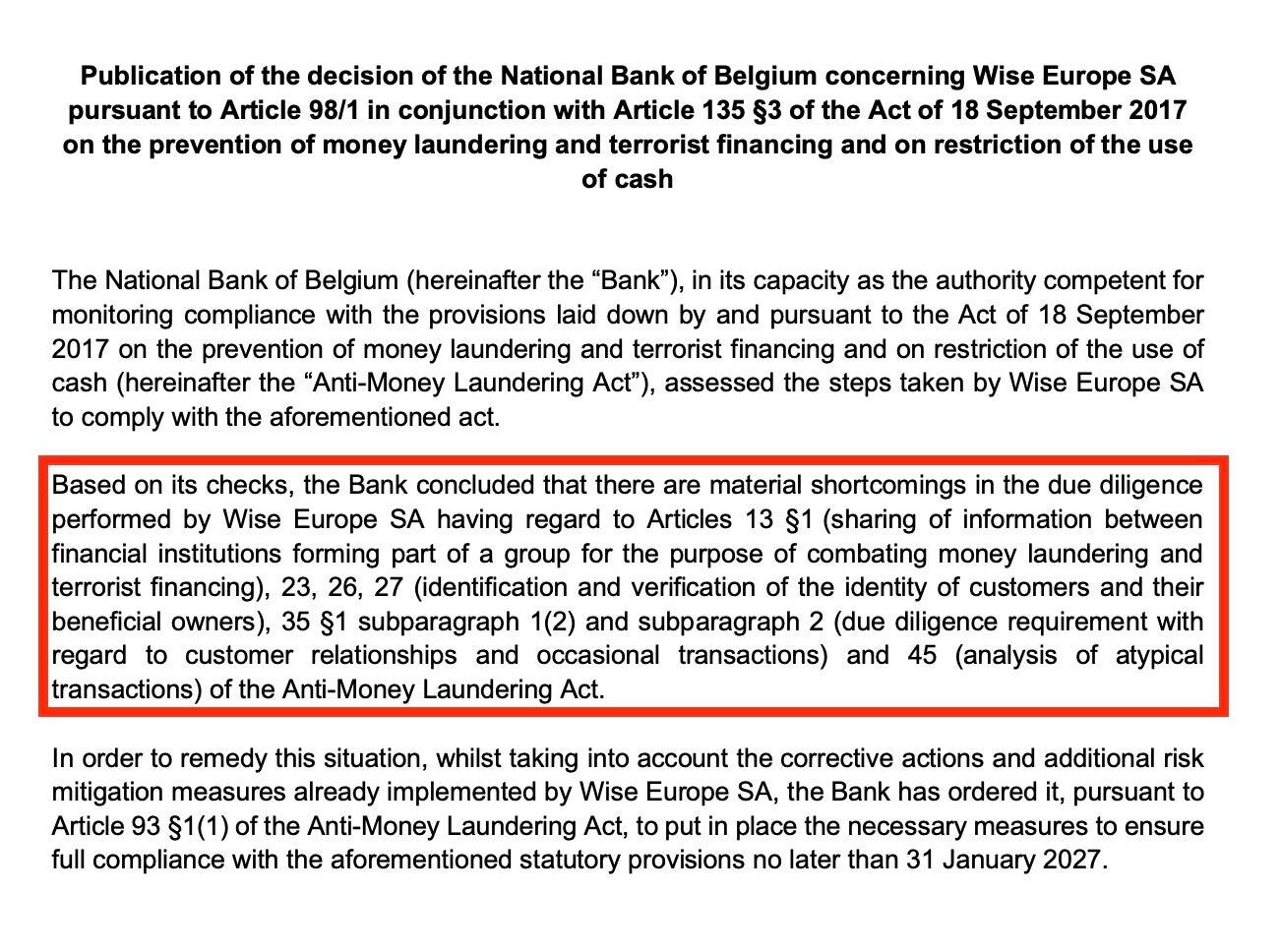
Now, the National Bank of Belgium (NBB) has made public the fact that Wise has failed to comply with a previously non-public order to remediate issues related to its anti-money laundering compliance obligations.
The documents reveal that, on July 8, 2025, the NBB issued Wise an order to comply with Articles 13 §1 (sharing of information between financial institutions forming part of a group for the purpose of combating money laundering and terrorist financing), 23, 26, 27 (identification and verification of the identity of customers and their beneficial owners), 35 §1 subparagraph 1(2) and subparagraph 2 (due diligence requirement with regard to customer relationships and occasional transactions) and 45 (analysis of atypical transactions) of the Anti-Money Laundering Act.
Wise was given until March 31, 2026, to come into compliance with the relevant requirements.
But, the documents show, Wise had failed to resolve any of the listed issues by the deadline, resulting in the first-ever "name and shame" publication of the company's failures.
The newly issued order requires Wise to come into compliance with the specified regulations no later than January 31, 2027.
CFPB To Pay Contractor $3 Million To Handle Synapse-Evolve Victim Claims Process
While most people have, understandably, moved on, the victims of the Synapse/Evolve disaster are still looking for resolution about what happened to as much as $95 million of their FDIC-insured deposits that remain officially unaccounted for.
The Consumer Financial Protection Bureau entered into a consent order with Synapse in August 2025, signed off on by the bankruptcy trustee (and former FDIC chair) Jelena McWilliams, allowing it to use money in its civil penalty fund to compensate victims.
Over $46 million was allocated from the CFPB’s fund last November — well shy of the range of $65 million to $95 million consistently cited in the bankruptcy proceedings.
According to the CFPB's website, an additional $8,965,767 was allocated from the penalty fund for Synapse/Evolve victims on May 29, 2026, bringing the total allocation to $55,214,058.
The CFPB has also hired a firm to handle the claims and reimbursement process, according to publicly available contracting records: Rust Consulting.
Yes, the same Rust that Evolve hired to handle payouts of the funds the bank said it held that belonged to end users. This actually isn't that surprising or odd, as the CFPB has used Rust on numerous other civil penalty fund cases.
Per the contract records, the CFPB will pay Rust $3,037,111.58 to handle the claims and disbursement process.
The records state a contract start date of August 11, 2026, and both a “current” and a “potential” end date of August 16, 2028 — suggesting the process could take as long as two years. This will likely be disappointing to end users who have been without access to their funds since May 2024, but is consistent with analysis of how long it has taken prior civil penalty fund cases to actually compensate victims.
[Paid Subscriber Exclusive] Rain’s $1 Million Hack Goes Largely Unnoticed, TabaPay, Which Almost Acquired Synapse, Is Buying A Bank, Bolt Says It’s Raising “Up To” $27 Million
Over $1 million was drained from consumers’ Rain-powered crypto spending cards last week, in a hack that has mostly flown under the radar, at least within the tradfi world.
Hackers exploited a vulnerability in an outdated version of crypto card infrastructure company Rain’s Solana “smart contract.”
Rain, valued at just shy of $2 billion in a fundraising round earlier this year, is a principal member of Visa, via a Puerto Rico entity that holds a money transmitter license in the U.S. territory — making the Puerto Rico Commissioner of Financial Institutions the card issuer’s primary regulator, including, presumably, for cybersecurity-related risks.