

Hey all, Jason here.
As many of you probably already know, I published a book last year that explores the opportunities, risks, and challenges of emerging banking business models.
While the book was written before the dramatic rise in interest in stablecoins as an “infrastructure” layer, the analysis and lessons remain as relevant as ever.
If you haven’t gotten a copy of my award-winning book, my publisher, Kogan Page, is running a 40% of promotion with discount code SALE40, if you buy it directly from them. The offer ends on February 2nd, so, if you’re interested, don’t delay!
You can also always grab it on Amazon, including for Kindle, here.
It’s Not The Opening of a Charter “Window.” The Regulatory Wall Protecting Incumbents Is Being Dismantled.
We probably should stop saying the charter “window” is open, as I don’t think a “window” would be big enough to squeeze through the number of companies seeking to form de novo banks.
In late January, the FDIC approved deposit insurance applications from Ford and General Motors affiliated with the automakers’ respective applications to charter Utah-based industrial loan companies.
The approval of deposit insurance — a prerequisite to actually being able to operate — for industrial loan companies (ILCs) has become an explicitly partisan issue.
The history is a long one, with partisan viewpoints on the topic becoming even more calcified after an official freeze on deposit insurance applications for ILCs in 2006 and in the wake of the 2008 financial crisis and subsequent financial and banking system reforms (Kiah Haslett chronicled the history of ILCs in a recent Fintech Takes Banking post here.)
Although Ford has long extended loans for the purchase of its vehicles through a captive finance arm, Ford Motor Credit, it has not previously operated a banking entity.
GM also has long operated a captive finance arm, General Motors Acceptance Corporation (GMAC), but it opted to form an industrial loan company in 2000 in order gather retail deposits to fund its lending business.
GMAC grew beyond its auto financing focus, including by expanding into mortgages in the mid-2000s (what timing!).
As the 2008 financial crisis metastasized, GMAC was converted from an industrial loan company into a Utah-chartered commercial bank. The Fed approved the creation of GMAC LLC as a bank holding company, such that the lender could access government-sponsored emergency support programs.
Ultimately, the government injected $17.2 billion of equity to rescue GMAC. GM eventually sold control of the bank to a consortium led by Cerberus. The government sold the last of its ownership stake in 2014, netting a total of $19.6 billion — a $2.4 billion profit on its initial investment.
GMAC was eventually renamed and is now known as Ally Financial.
It is, perhaps, a sign of the current stage of the never-ending cycle of unbundling and rebundling that GM will again own and operate a bank.
Hopefully, this time, it won’t end in a government bailout (even if it was a profitable one for U.S. taxpayers!)
Brazil-based NuBank has won conditional approval of its OCC application to charter a national bank, NuBank, N.A.
The company claims to serve 127 million customers. Its home market of Brazil is by far its largest, with approximately 110 million users, but NuBank has also made in roads in LatAm’s second largest market, Mexico (~12 million customers), and Colombia (~4 million customers).
NuBank intends to offer deposit accounts, credit cards, loans, and digital asset services in the U.S. Having secured conditional approval, NuBank now must raise the new entity’s capital within a year and operationalize the bank within 18 months.
NuBank cofounder Cristina Junqueira, who has relocated to the U.S., will lead the new bank’s development. Junquiera commented on the conditional approval, saying, “We look forward to delivering the transparent, efficient financial experiences already trusted by more than 127 million customers around the world to our future customers in the U.S.”
Meanwhile, U.K.-based Revolut has announced a change of strategy — yet again — on its plans to get a charter in the U.S. It’s hard to take the company at its word, given it has floated trial balloons in the press about an American bank charter at least as far back as 2021, when it claimed it would apply for a state bank charter in California and corresponding deposit insurance.
Revolut never filed such applications.
As recently as September 2025, Revolut was saying it was considering buying a bank in the U.S., where it currently operates through partnerships with Lead, Cross River, and Sutton, to accelerate its global expansion.
Now the company is telling reporters it has scrapped those plans, as it believes it may be a faster process to seek a de novo charter from the OCC — an understandable point of view to hold, given how quickly others, even those seeking deposit-taking charters, have seen their applications approved.
Spanish Language Neobank Seis Says “Adios”
Joshua Howland, cofounder and president of Y Combinator-backed neobank Seis, announced last week that the company is shutting down.
Other investors in the company include F-Prime Capital, Pioneer Fund, and Duro Ventures, as well as individual investments from Immad Akhund (cofounder/CEO of Mercury), Austen Allred (founder of controversial for-profit bootcamp Lambda School aka BloomTech), and Harry Hurst (cofounder of Pipe), according to data from Pitchbook.
Seis aimed to offer banking services to some of the 40 million to 45 million people in the U.S. for whom Spanish is their primary language.
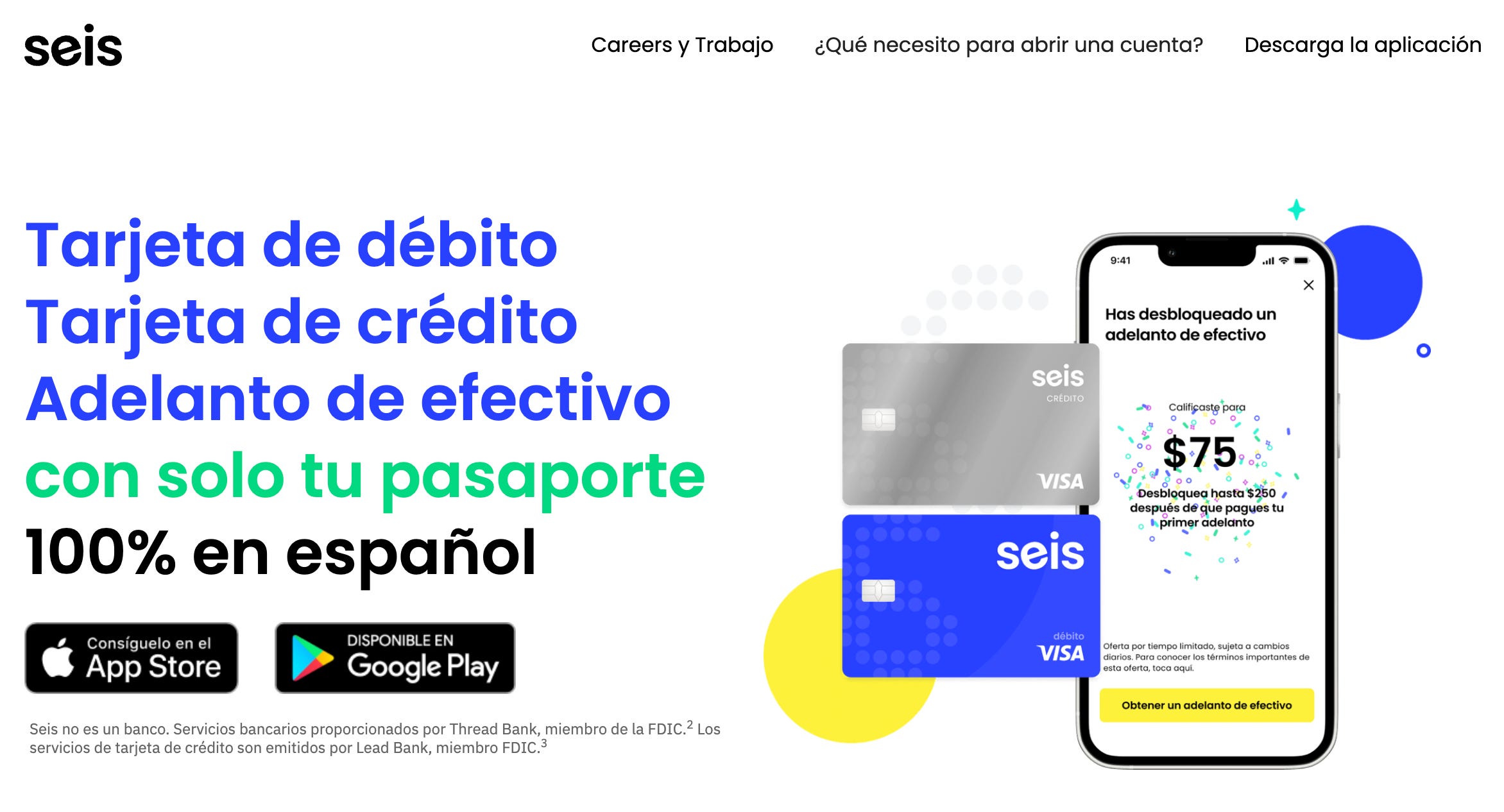
Seis offered a website and app in Spanish, with the ability to open an account with a passport and ITIN (individual taxpayer identification number), a government-issued identifier that enables people who do not qualify for a Social Security number to pay legally required taxes (eg income/payroll).
Seis worked with middleware intermediary Unit and underlying bank partner Thread Bank, as well as offering a secured credit card and cash advances through a partnership with Lead.
According to cofounder Howland’s post, Seis “opened accounts” for more than 500,000 people and grew to $10 million in revenue in the 16 months after it launced in 2021.
In explaining what led the company to shutdown, Howland wrote, “There's a lot to say here, but the short story is that immigration patterns changed and we saw less demand for our product.”
The failure of Seis demonstrates the stark realities of the economics of the neobanking business model, especially for companies that haven’t achieved sufficient scale.
At its base tier, Seis users incurred no monthly fee only if they spent at least $1,500 per month with their Seis debit card. Per U.S. Census data, the median gross income for Hispanic households (not a perfect proxy but reasonable) is $65,000.
Actual household take home pay would vary based on exemptions, state income taxes, and other payroll deductions, but would end up approximately in the $45,000 to $50,000 range, or, taking the midpoint, about $4,000 per month.
When many of households' biggest expenses generally cannot be paid by card (rent/mortgage, child care), hitting that $1,500 per month threshold could actually be quite difficult for Seis users — some of whom no doubt could find fee-free banking products elsewhere.
While Seis’s Howland pointed to changing immigration patterns leading to reduced demand, an alternate way to interpret that is that Seis, like other neobanks and wallets, probably had a churn problem.
When users can easily open and switch between products, retention is a challenge, and many startups pour money into marketing to acquire new customers rather than solving the fundamental churn problem.
Seis faced competition not only from money center banks and mainline neobanks and wallets (Chime, Venmo, Cash App), but also from the rapidly emerging set of stablecoin-based banking-like products.
App store analytics suggest Seis’ downloads stalled out about a year ago.
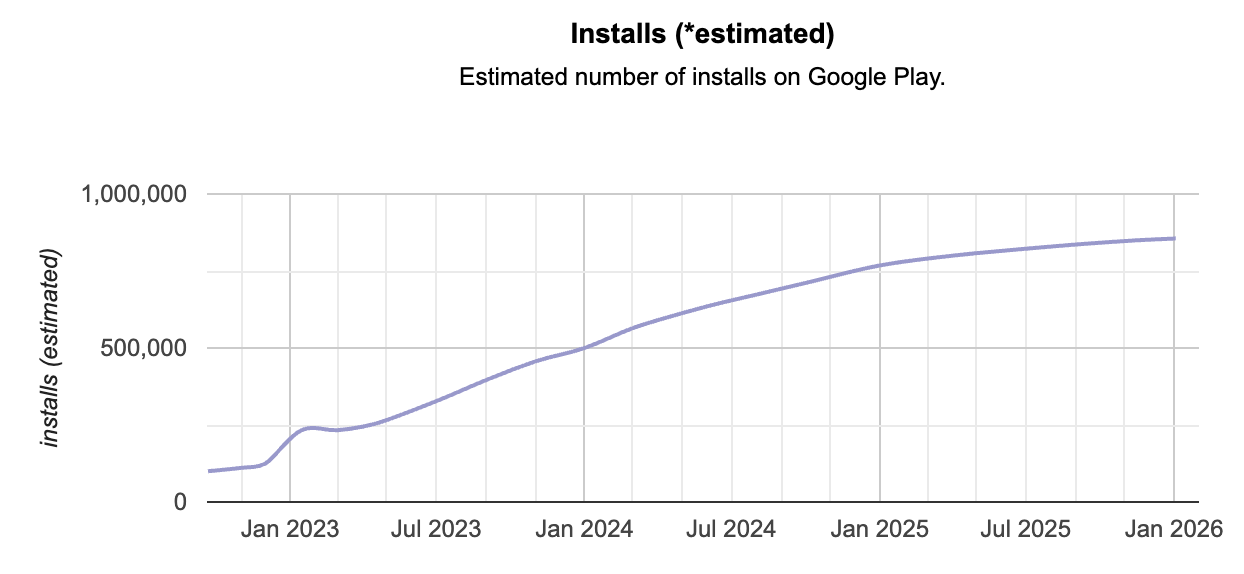
Without new users coming in, whether due to shifting immigration policies, a reduction in Seis' marketing spend, or both, Seis would've seen revenue growth stall and fall into reverse, without necessarily seeing matching drops in opex.
The sunsetting of Zelle’s standalone app also likely hurt Seis’ business. While many Americans use Zelle as part of their banking app, the standalone Zelle app was disproportionately popular with Latino users. When the Zelle app was deprecated in spring 2025, it disrupted a key channel for Seis users to onboard funds.
Ultimately, splitting revenue with numerous service providers vs. the cost of customer acquisition and operating expense appears to have been unsustainable for the company.
Tether Announces “On Shore” Stablecoin, USA₮
Tether calls its newly launched USA₮ a "federally regulated" stablecoin. While that makes for a good marketing message, at present, there is no such thing as a “regulated” stablecoin (yet).
Tether has a good business going. Its original stablecoin, USDT (commonly also referred to simply “Tether”), has the highest circulation of any USD-pegged cryptocurrency, with about $186 billion outstanding. That’s a drop in the bucket vs. the US dollar M2 money supply, which stands at approximately $22.5 trillion.
Still, Tether presumably holds the $186 billion worth of assets that back USDT — assets it is earning a return on. The company claimed to earn $10 billion in profit from Q1-Q3 2025, according to its “attestation” reports.
The U.S.’ move to regulate stablecoins posed a dilemma for Tether: coming into compliance with the yet-to-be-finalized implementing regulations could mean less volume, due to anti-money laundering requirements, and lower profitability, due to the restrictions on permissible reserve assets.
Tether’s answer? Launch an “on shore” stablecoin, USA₮, while continuing to offer USDT outside of the United States.
The company announced the official launch of USA₮ last week, describing it as a “federally regulated, dollar-backed stablecoin.” The description, though, is belied by Tether’s own press release.
While Anchorage Digital, an OCC-chartered bank, is the issuer (this is the “federally regulated” part, I guess), the release goes on to refer to “a potential framework for federal oversight [emerging]" and USA₮ being “designed to operate within the GENIUS Act’s new federal stablecoin framework.”
As of today, applicable regulatory agencies (OCC, FDIC, FRB, NCUA and state financial regulators) haven’t even finalized the application process to be licensed as a “permitted payment stablecoin issuer,” so it should go without saying that Tether, nor its issuing bank partner Anchorage, are currently licensed as such.
Additional regulations around anti-money laundering controls, capital, liquidity, and risk management and supervision and examination processes also must be defined. For those that read beyond the headlines and press releases, this shouldn't come as a surprise.
All to say, describing USA₮ itself as “federally regulated” seems more like a marketing ploy than a material differentiator, at least at the moment.
Kontigo, Operating With Expired SUNACRIP License, Promises “Internal Review” Over Compliance Failures, Potential Sanctions Violations
Kontigo, the Y Combinator-backed Venezuelan crypto app, went silent on social media for several weeks following the bombshell report on how the app could be used to evade sanctions on the country and to launder funds — including through Kontigo’s business relationships with well-known names in fintech and crypto like Stripe, Bridge, Rain, and PayPal.
In addition to Y Combinator, other key investors backing the Venezuelan crypto app include Coinbase Ventures, which led the $20 million round Kontigo announced in December 2025, as well as HF0, Bayhouse Capital, and Alumni Ventures.
As of Monday, January 26th, it appears that all known U.S. service providers that offered the ability for Venezuelan consumers and business to on-ramp dollars from the U.S. into USDC in Kontigo have cut ties with the company, though users do appear to still be able to on-ramp funds from Colombian pesos to USDC in Kontigo via PSE bank transfer.
Now, Kontigo is claiming it will conduct an “internal review” and that the company is “committed to complying with U.S. laws, including sanctions.”
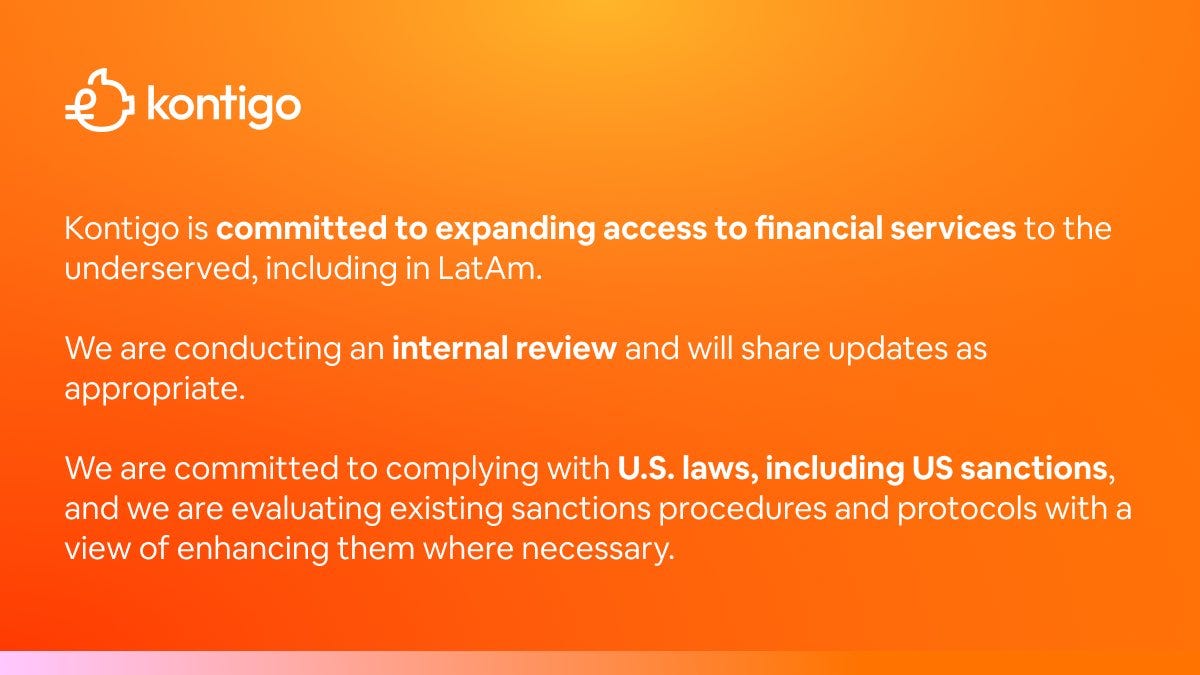
Kontigo and the company’s cofounder and CEO, Jesus Catillo, did not respond to questions about who, exactly, is conducting said review or what the review consists of.
Based on review of LinkedIn users who identify Kontigo as their employer, the company appears to have no legal or compliance personnel.
One crypto industry analyst pointed out that Kontigo’s statement is in English, despite a customer base that is overwhelming composed of Spanish language users. The language choice suggests the “internal review” may be more geared to Kontigo’s American audience of service providers and investors, rather than its actual customers.
An additional wrinkle: Kontigo’s Venezuelan crypto license, held by subsidiary Oha Technologies, expired on January 8, 2026.
The Venezuelan regulator responsible for such licenses, SUNACRIP, is ostensibly undergoing “reorganization” following the $17 billion PdVSA-crypto scandal.
Since its inception, the committee in charge of reorganizing SUNACRIP has been led by Anabel Pereira Fernández — who also currently holds roles as the Vice President of the Central Bank of Venezuela, the Vice President for International Supply and Trade and a principal board member at state oil company PdVSA, and the Minister of Economy and Finance.
It is unclear if SUNACRIP has granted Kontigo subsidiary Oha an extension or new license to continue operating as a crypto exchange in the country — though, on January 2, 2026, SUNACRIP did grant a new license to Crixto, the only crypto firm confirmed to be officially licensed in the country.
Things To Know & Other Good Reads
First Independence Bank, Detroit, Michigan, Assumes All Deposits of Metropolitan Capital Bank & Trust, Chicago, Illinois (FDIC)
Banks Urge OCC to Increase Scrutiny of Core Service Providers (Bloomberg Law)
CFPB Returns to Full Open-Banking Rewrite After Cash Infusion (Bloomberg Law)
Kevin Warsh’s nomination as Fed chair to spark rethink of bank’s role (FT)
He Leaked the Secrets of a Southeast Asian Scam Compound. Then He Had to Get Out Alive (Wired)
‘Spy Sheikh’ Bought Secret Stake in Trump Company (Wall Street Journal)
DailyPay seeks to dismiss NY lawsuit (Payments Dive)
Crypto bill clears U.S. Senate milestone despite Democrat opposition (CoinDesk)
What the Changing Credit File Means for Non-Prime Auto Lenders (Non-Prime Times)
The Economic Case for Credit Card Interest Rate Caps (Open Banker)
The housing theory of everything (Works in Progress)
Capital One Buys Brex (Fintech Takes)
About Fintech Business Weekly
Looking to work with me in any of the following areas? Email me.
Now available: buy my best-selling book, Banking as a Service: Opportunities, Challenges and Risks of New Banking Business Models, here
Vendor, partner & investment opportunity advice and due diligence
Fintech advising & consulting
Sponsoring this newsletter
News tip or story suggestion — reach me on Signal at mikulaja.01