

Hey all, Jason here.
This newsletter should be hitting your inbox about the time I arrive back in Utrecht from a short stay in Paris. It’s been a lovely couple of days in the City of Lights, even if I spent too much of it double-checking my understanding of whether or not the CFPB’s finalized open banking rule, which (for the moment!) still exists, allows banks to charge third-parties, like data aggregators Plaid and MX, for accessing consumers’ data on their behalf (conclusion: it does not.)
Unmasking Modern Fraud 🎭
Sponsored content: As fraud schemes become more advanced and widespread, fintechs often fall behind—investigating incidents only after the damage is done.
Is your team equipped to stop fraud in real time? ⚡🛑
Tune in August 7th at 10am PT to learn how device intelligence combined with real-time decisioning is helping detect threats earlier, before the funds are gone.
It’s not a discussion you’ll want to miss!

Connecticut, CSBS Block Release of State’s Accreditation Report
Earlier this year, Fintech Business Weekly filed a freedom of information request seeking the Conference of State Bank Supervisors’ accreditation report from the Connecticut Department of Banking.
The Connecticut Department of Banking describes the content of the accreditation report as showing its “regulatory excellence and industry leadership.”
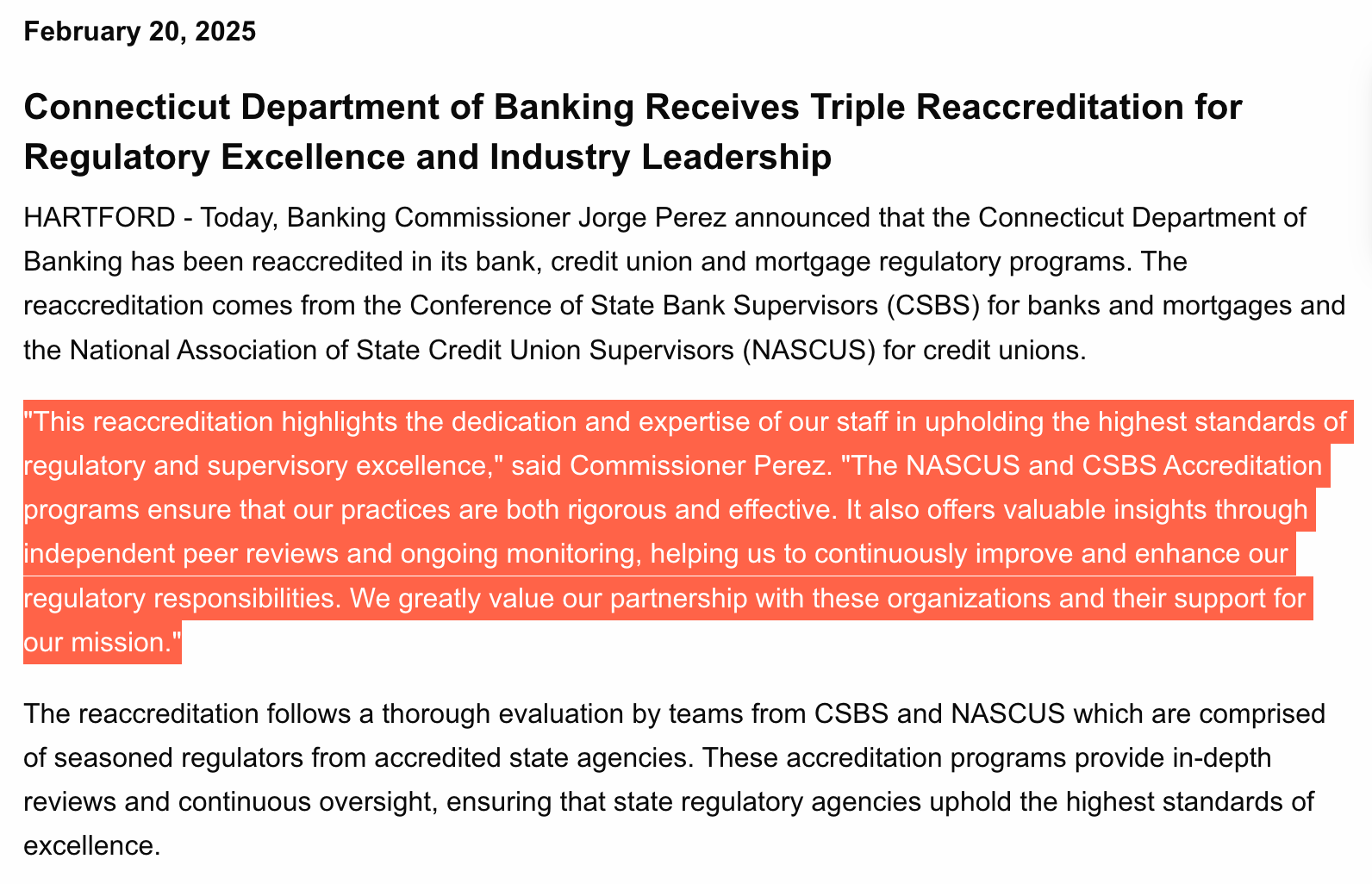
Yet, the Department initially declined the freedom of information request, saying that, “the Commissioner has determined that disclosure of the accreditation report could affect the safety and soundness of the banking system in Connecticut and the state banking accreditation process and is not in the public interest.”
Given that it was and remains unclear how a report showing the Department’s purported regulatory excellence could undermine the entire state banking system, this publication appealed the decision to the Connecticut Freedom of Information Commission, which is the venue to adjudicate such disputes.
In the course of the preparing for the hearing in the matter, the Department appears to have contacted the Conference of State Bank Supervisors regarding the request.
CSBS responded to the state banking commissioner, Jorge Perez, arguing that such accreditation reports are intellectual property of CSBS and are derived from trade secrets underlying the accreditation program, essentially arguing that the Department couldn’t release the accreditation report publicly even if it wanted to.
The letter, signed by CSBS General Counsel Margaret Liu, claims (emphasis added):
“If the details of a review are made public, they could be used to inappropriately undermine confidence in an agency and, by extension, the entities they charter, regulate, and supervise. Accordingly, confidentiality is a critical component of accreditation reviews, including the CSBS Report provided to you.”
While a hearing in the matter was scheduled for tomorrow (Monday, July 28th), Fintech Business Weekly has been forced to withdraw its complaint, as the Freedom of Information Commission requires in-person appearances and was unwilling to make accommodations for a remote or virtual appearance.
Asked for comment on its decision not to release the report, a Connecticut Department of Banking spokesperson said:
“After careful consideration, the Department determined that federal and state law preclude it from providing you with a copy of the CSBS accreditation report. We understand that you may disagree with those legal determinations and because the Connecticut FOIC and Connecticut state courts may ultimately be called on to resolve these issues, the Department has no further comment.”
It remains unclear how releasing an accreditation report that the Connecticut Department of Banking touts as demonstrating its “regulatory excellence” could, somehow, undermine the safety and soundness of every bank in the state.
FHFA Director Pulte’s One-Sided War on Fed Chair Jerome Powell: Briefly Explained
If you’re not a resident of the fever swamps of X, you may be blissfully unaware of just how very online Bill Pulte, President Trump’s appointee to lead the Federal Housing Finance Authority, is.
I’ll admit, the FHFA, which oversees the Federal Home Loan Bank system and government-sponsored entities Fannie Mae and Freddie Mac, have not historically been a corner of the banking and finance world that I’ve paid much attention to.
FHFA’s stated mission is to ensure the entities it oversees “fulfill their mission by operating in a safe and sound manner to serve as a reliable source of liquidity and funding for the housing finance market throughout the economic cycle.”
Pulte has used his role as Director of FHFA and his bully pulpit on X, where he has some three million followers, to advocate for policies he believes will help make home ownership more affordable and accessible.
Policies Pulte has advocated for or enacted include allowing Fannie Mae and Freddie Mac to buy mortgages underwritten with FICO competitor VantageScore, incorporating rental payment history into mortgage underwriting, terminating special purpose credit programs, and addressing mortgage fraud.
Pulte has also made some less traditional decisions, like appointing himself as chairman of Fannie Mae and Freddie Mac and placing FHFA’s general counsel on the GSEs’ boards.
But its Pulte’s frequent and aggressive attacks on Federal Reserve Chairman Jerome Powell — who Trump himself originally appointed, in 2017 — that have understandably drawn the most widespread media attention.
Pulte, himself the heir to one of the country’s largest homebuilding firms, has been bombastically echoing President Trump’s incessant calls for Powell to lower interest rates, though it’s worth pointing out that rate decisions are reached by a vote of the 12-member Federal Open Market Committee — not unilaterally set by the Fed Chair.
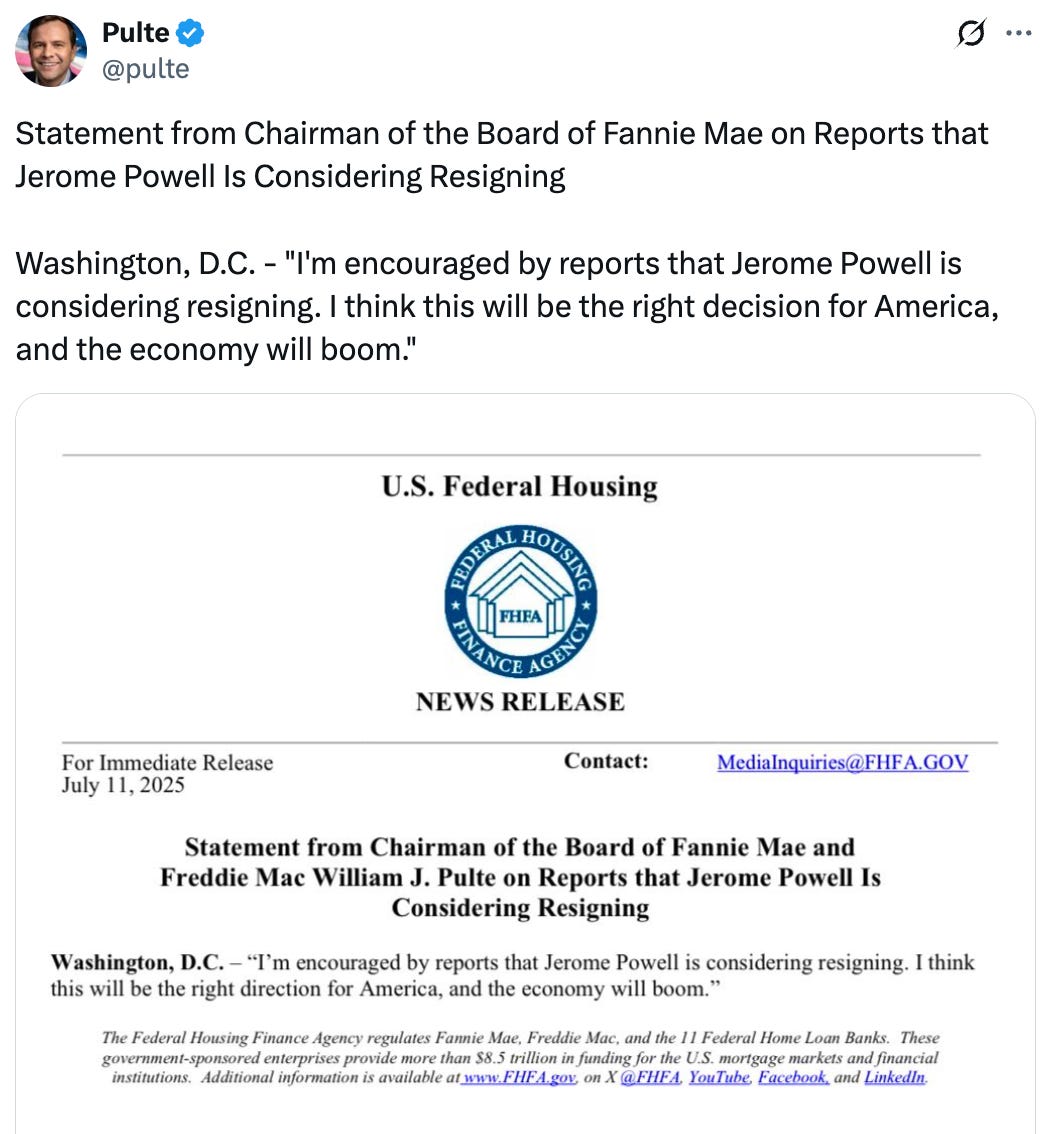
Pulte’s attacks include alleging that Powell is “conducting economic warfare against America,” presumably by not lowering interest rates.
In recent weeks, Pulte has zeroed in on the ballooning cost of the renovation of the Federal Reserve’s headquarters, referring to the situation as a “scandal” and alleging that Powell “lied when asked about the specifics before Congress.”
The “renovation scandal” that Pulte has been pushing reached a cartoonish level with an unprecedented and surreal site visit to the Fed by President Trump and Senator Tim Scott (R-SC), during which Trump falsely claimed the price tag for the renovations had reached $3.1 billion.

The amount cited by Trump, which Senator Scott reiterated, includes the cost of the construction of a separate building completed five years ago.
Pulte’s social media activity has understandably raised eyebrows, including earning him a sternly worded letter from Senator Elizabeth Warren (D-MA).
Warren’s six-page letter says in part (spacing adjusted and emphasis added):
As the Director of the Federal Housing Finance Agency (FHFA), you have a critical role to play in promoting mortgage market liquidity, ensuring safety and soundness, and supporting access to homeownership and housing, including by reducing costs for American families.
Yet, in recent weeks, you appear to have become distracted from your statutory mission. Instead, you appear to have been primarily focused on convincing President Trump to illegally fire Jerome Powell, the Chair of the Board of Governors of the Federal Reserve System (“the Fed”).
Warren also highlighted some of Pulte’s Powell-related posts on X:
“SITE PLAN: Why is the Federal Reserve buying ‘Granite Clad’ rails?”
“Jerome Powell spent more money on his office renovations $2.5B than it took the Dallas Cowboys to build an entire stadium. Why is nobody talking about this?”
“It looks like I will be able to tour the Fed’s $2.5 Billion Building Renovation, which is good, because I believe it’s riddled with Fraud and likely explains the gross negligence that Jerome Powell has exhibited in his ‘hallucinations’ that tarriffs [sic] cause inflation (they don’t).”
“As someone with deep experience in construction, I am requesting to tour the Fed building and the new, ridiculous “renovations”, which I believe are riddled with fraud.”
“Jerome Powell is 72 years old, wealthy, doesn’t need a mortgage, doesn’t need a credit card, doesn’t need a car loan, and he doesn’t like our Great President.”
A cartoon of Chair Powell lounging on a pool float in a fountain, drink in hand with money floating around him, in front of the Federal Reserve Building
Senator Warren’s letter requests Pulte’s response to 10 questions, including how much time Pulte spends “posting on, scrolling, or otherwise consuming social media content” during the workday.
For his part, Pulte appears to be taking Warren’s letter in stride, describing it as a “nastygram” and posting this image of Fed Chair Jerome Powell on a pool float and Senator Warren in Native American-esque attire, presumably a reference to past controversial claims from Warren that her family had indigenous heritage.

The situation has put Warren in the interesting position of defending the Federal Reserve and Powell, whom she has previously called “a dangerous man whose actions make our banking system less safe.”
Warren has also criticized the Fed for its oversight of Evolve Bank & Trust amid the meltdown of fintech middleware Synapse, which led to thousands of depositors losing as much as $95 million in funds that are still unaccounted for. Warren wrote this spring that “[t]here were several troubling warning signs that should have prompted immediate supervisory and enforcement intervention from the Federal Reserve, which could have avoided, or at least mitigated, the damage.”
I Thought Faster Payments Fixed This
The Clearing House, a consortium of some of the country’s largest banks, launched its Real-Time Payments network (RTP) in 2017.
Even before RTP first debuted in 2017, there was an option for cheap, faster payments: Nacha debuted Same-Day ACH in 2016. And by 2021, Same-Day ACH supported three intra-day settlement windows.
And the Federal Reserve launched its own instant payment solution, FedNow, in 2023.
According to The Clearing House, its RTP network reaches 71% of US demand deposit accounts (DDAs), with incremental “technical reach” to financial institutions that cover 90% of DDAs.
While FedNow has seen somewhat slower uptake, more than 1,400 banks, including the country’s largest, have integrated the payment rail, though some have opted to only enable the ability to receive payments.
The older Same-Day ACH capability reaches virtually every bank in the United States, thanks to the preexisting ubiquity of ACH via the two network operators: the Electronic Payment Network, administered by The Clearing House, and the Federal Reserve, which operates FedACH.
The per transaction cost to banks for these faster or real-time payment methods is small. A FedNow credit transaction costs banks $0.045. The Clearing House doesn’t publicly disclose a fee schedule for RTP, but it’s reasonable to assume it is priced comparably to FedNow. And the incremental cost for Same-Day ACH vs. standard next business day ACH is de minimis.
So why aren’t consumers and businesses in the United States benefiting from ubiquitous, cheap, fast payments?
To be fair, there are costs associated with banks’ payment infrastructure beyond the per transaction costs incurred from payment network operators, and they logically and understandably charge users, including non-bank fintech firms that need access to payment rails, rates that exceed these baseline costs.
But customer-facing services, for both consumers and business, often charge far in excess of even a reasonable markup for faster payments.
Why? Because they can!
An example of this landed, unsolicited, in my inbox last week.
A client of mine uses popular spend management platform Ramp (which, somehow, is “in talks” to raise funds at a $21 billion valuation, a month after raising at a $16 billion valuation, but that’s another story.)
Ramp is not a bank, though in addition to its expense management and bill pay products, it does offer business banking services, via partner First Internet Bank of Indiana.
If a Ramp customer uses Ramp’s banking product, they can opt to have an invoice paid from that account, with Ramp offering them, as payor, the option to use Same-Day ACH at no cost, according to the company’s documentation.
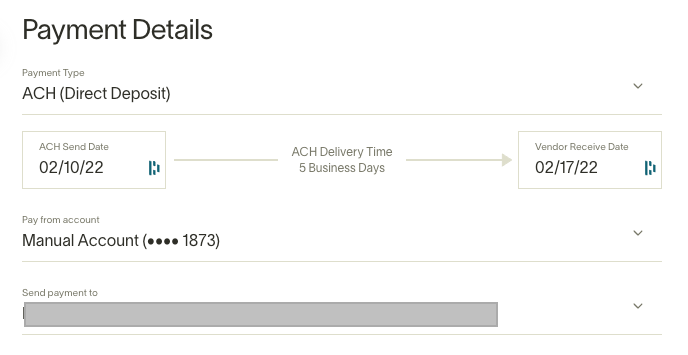
If a Ramp customer is not using Ramp’s banking product, Ramp needs to initiate a debit against their external bank account and initiate a credit to the payee — if the Ramp customer wants to use Same-Day ACH in this scenario, Ramp charges them a $10 fee.
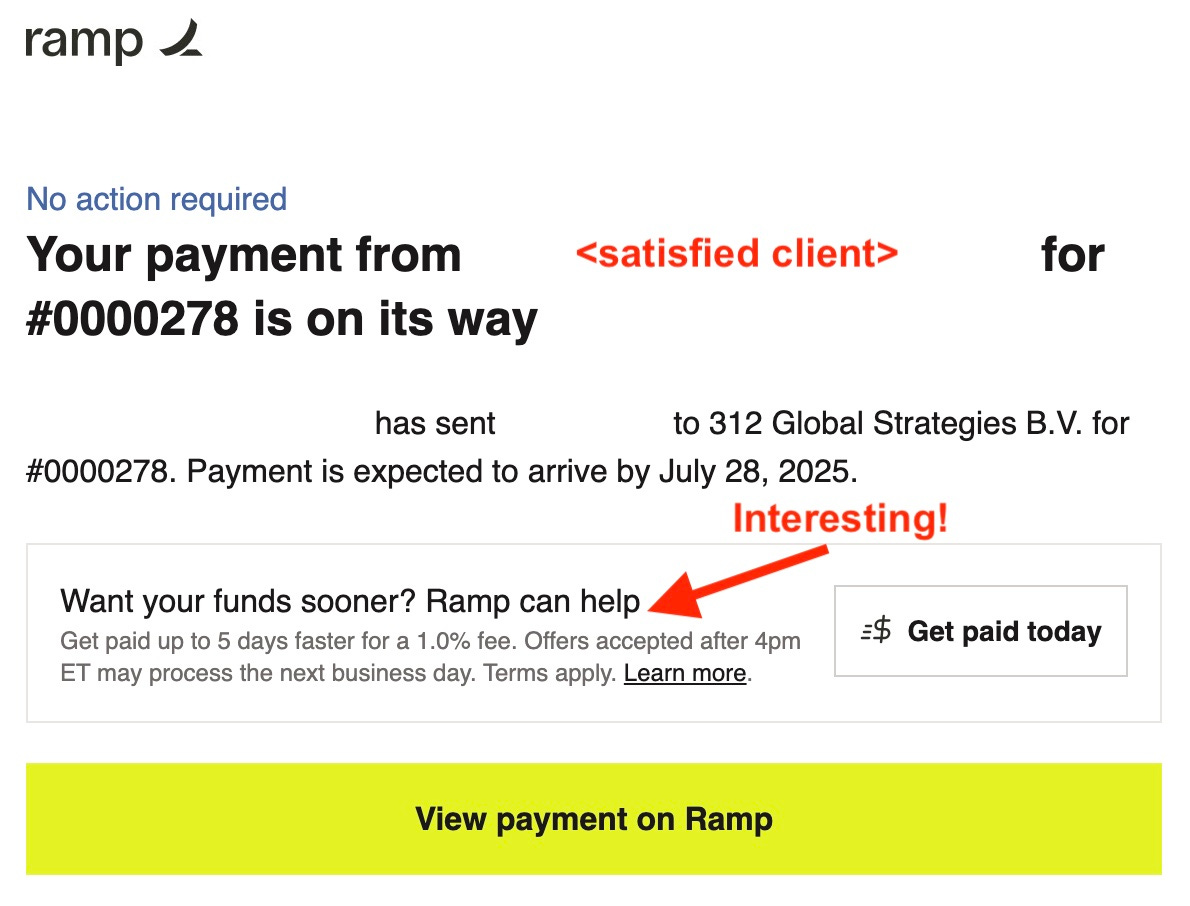
In my case, I can’t be sure if my client is or is not using Ramp’s banking product, but given the five business day timeline described in the payment advice, I suspect they are not.
My business, 312 Global Strategies BV, is not a Ramp customer, but the company offered me the ability to “get paid up to 5 days faster” — for a flat, uncapped 1% of the amount of the invoice.
For a hypothetical $15,000 invoice, that would equate to a $150 fee.
According to Ramp’s documentation, “After accepting the offer, Ramp changes the payment to same-day ACH for faster delivery,” though the terms and conditions actually specify that service “may be facilitated by Ramp or its Financial Institution Partners through a variety of payment networks, in our discretion, including but not limited to Same-Day ACH or the Real Time Payments (“RTP”) network.”
I’ll admit, this is slightly more complex than I initially thought, assuming, in my case, that Ramp is initiating a debit against my client’s external bank account and crediting my account.
There does appear to be actual incremental risk to Ramp, if it were to disburse funds to me via Same-Day ACH, while debiting funds from my client via traditional ACH.
So charging a fee here doesn’t appear to be purely an arbitrage of marking up the de minimis cost of Same-Day ACH or RTP — though the size of the fee seems wildly out of proportion with that risk, and Ramp’s documentation makes clear it takes other factors into account to mitigate this risk:
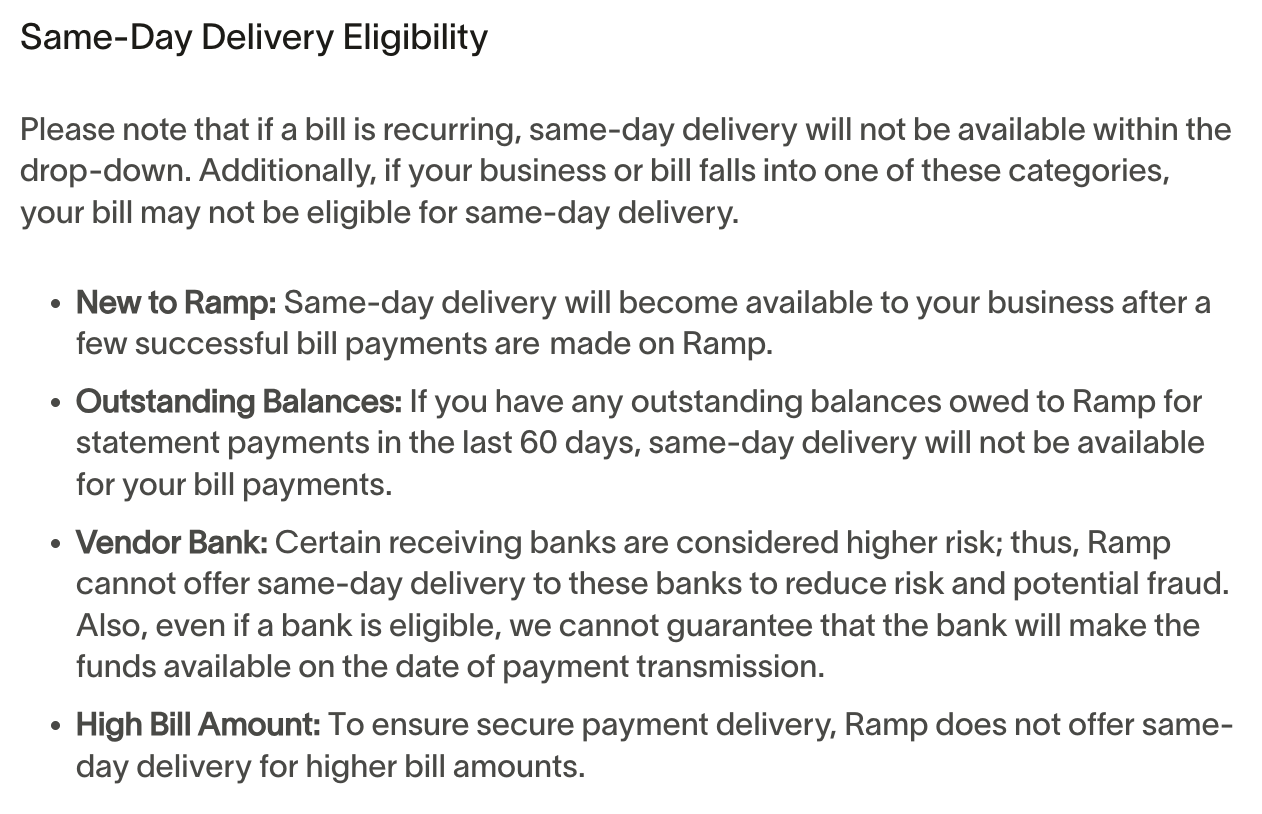
To be fair to Ramp and as plenty of commenters pointed out, Ramp is hardly the only company, whether serving businesses or consumers, that engages in this practice, though I do wonder how Ramp’s customers view the company monetizing their vendor relationships in this fashion.
Popular peer-to-peer payment apps Venmo and Cash App charge fees that range from 0.5% to 1.75%, though Venmo caps the maximum fee at $25, and it’s not an apples-to-apples comparison, as these services typically use push-to-card for instant transfers via networks like Visa or Mastercard, rather than RTP or FedNow.
While the US may finally have “faster payments,” the fractured banking and payments landscape — and fintechs’ tendency to use faster payments as a profit center — remain major barriers to widespread adoption.
1033 Data Fee Fight Highlights Bank/Fintech Divide
There has been no shortage of hot takes and analysis on the recent news that JPMorgan Chase intends to begin charging third-parties to access consumers’ banking data on their behalf.
It’s hard to know if the bank expected this level of reaction from users of that data — largely non-bank fintechs — but, as Scott Harkey pointed out last week, it’s not like JPMorgan Chase couldn’t foresee the proposed pricing information it shared showing up in the press. In fact, it may have been counting on it.
The fee fight is exacerbating a longstanding fault line in the US financial services ecosystem, between chartered banks, especially the country’s largerst, and non-bank fintechs.
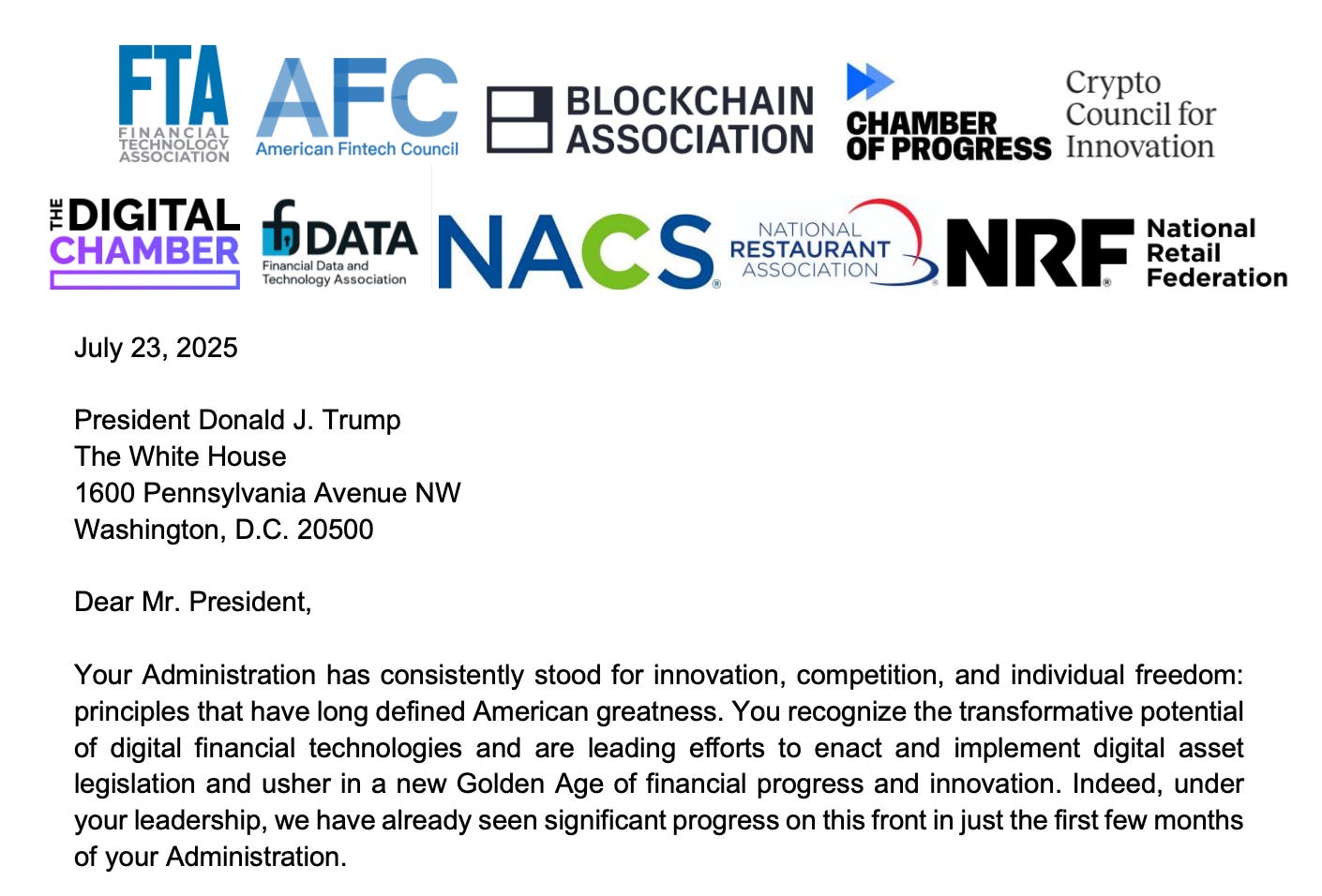
Trade associations that represent a wide range of types of firms — fintech, yes, but also blockchain, crypto, and retailers — attempted to draw attention to the potential repercussions of Chase’s move in a letter last week addressed directly to President Trump.