

Hey all, Jason here.
I’m looking forward to a beautiful spring week in Mexico City — my favorite time of year. This will be my last full week here, before I’m on to my next stop, so I plan to make the most of it.
From Alerts to Action: The Rise of Autonomous AI in Financial Crime
Partner content: Alerts aren’t the problem—execution is.
As volumes grow, risk teams are under pressure to investigate faster and deliver defensible outcomes. AI is changing how that work gets done.
Hear from leaders at Equifax, FS Vector, Liminal, and Unit21 on March 25 as they discuss how AI agents are transforming financial crime operations from insight to action.
If AI is on your roadmap, this is a timely conversation to help validate your approach.

CinCin: Cheers to Money Laundering
“Cin cin” is a popular toast in Italian — the equivalent of saying “cheers” when you clink glasses. It is also the name of a Telegram-based “no KYC” crypto card service.
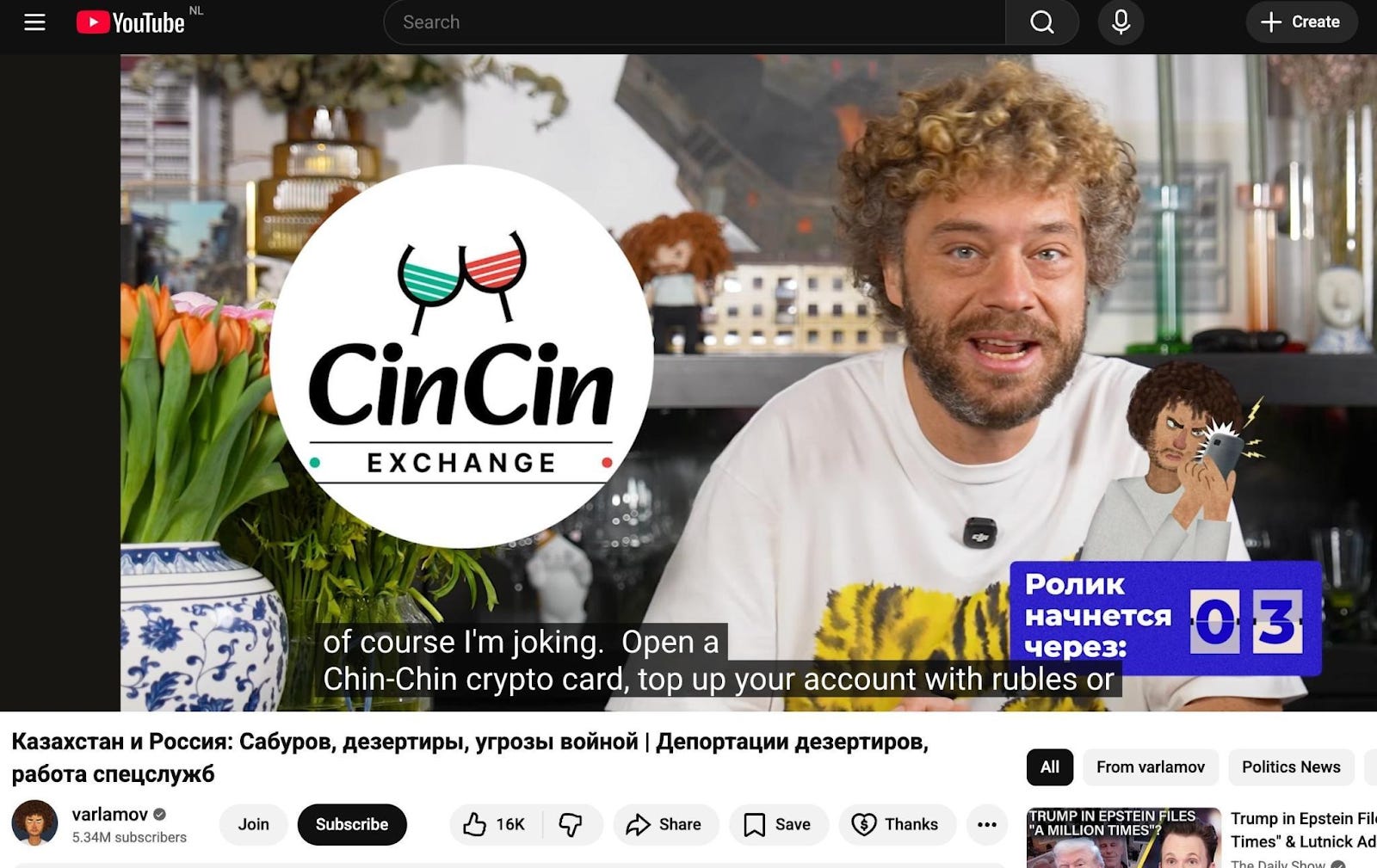
The company, which does business under the name CinCin Exchange, is officially known as Sonder Inc., according to its terms and conditions, and is legally based in the tiny Republic of the Marshall Islands.
CinCin appears to specifically target its services to Russian and Ukrainian speakers and even has influencer marketing partnerships with comedian Danila Poperechny, YouTuber Petya English, and rapper KyivStoner.
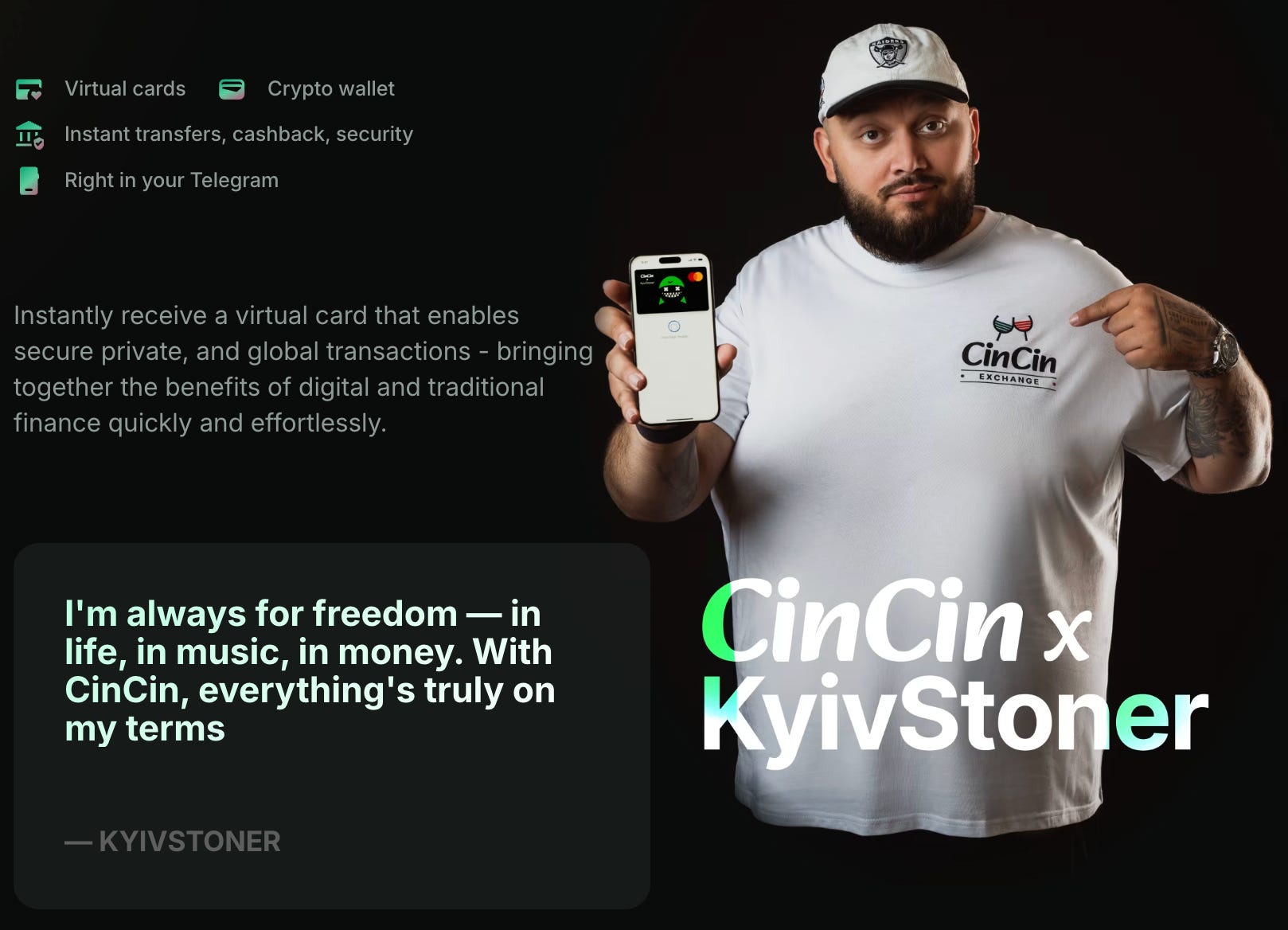
CinCin operates much the same as other so-called “No KYC” crypto spending cards.
Users can fund a wallet on the platform by depositing popular crypto or stablecoin assets, including USDT (Tether) on the Tron blockchain. The Tether/Tron combination is generally understood to be the preferred vehicle for illicit activity, owing to the speed and lower costs of Tron vs. other blockchains and deeper liquidity of Tether on Tron specifically.
Analysis of wallet addresses associated with CinCin suggest the company has seen more than $5 million in deposits via Tron between February 6th and last week — and this number only takes into account a single token on a single chain.
CinCin users aren’t constrained to using stablecoins. They can also deposit bitcoin, ether, and even President Trump’s “memecoin,” $TRUMP.
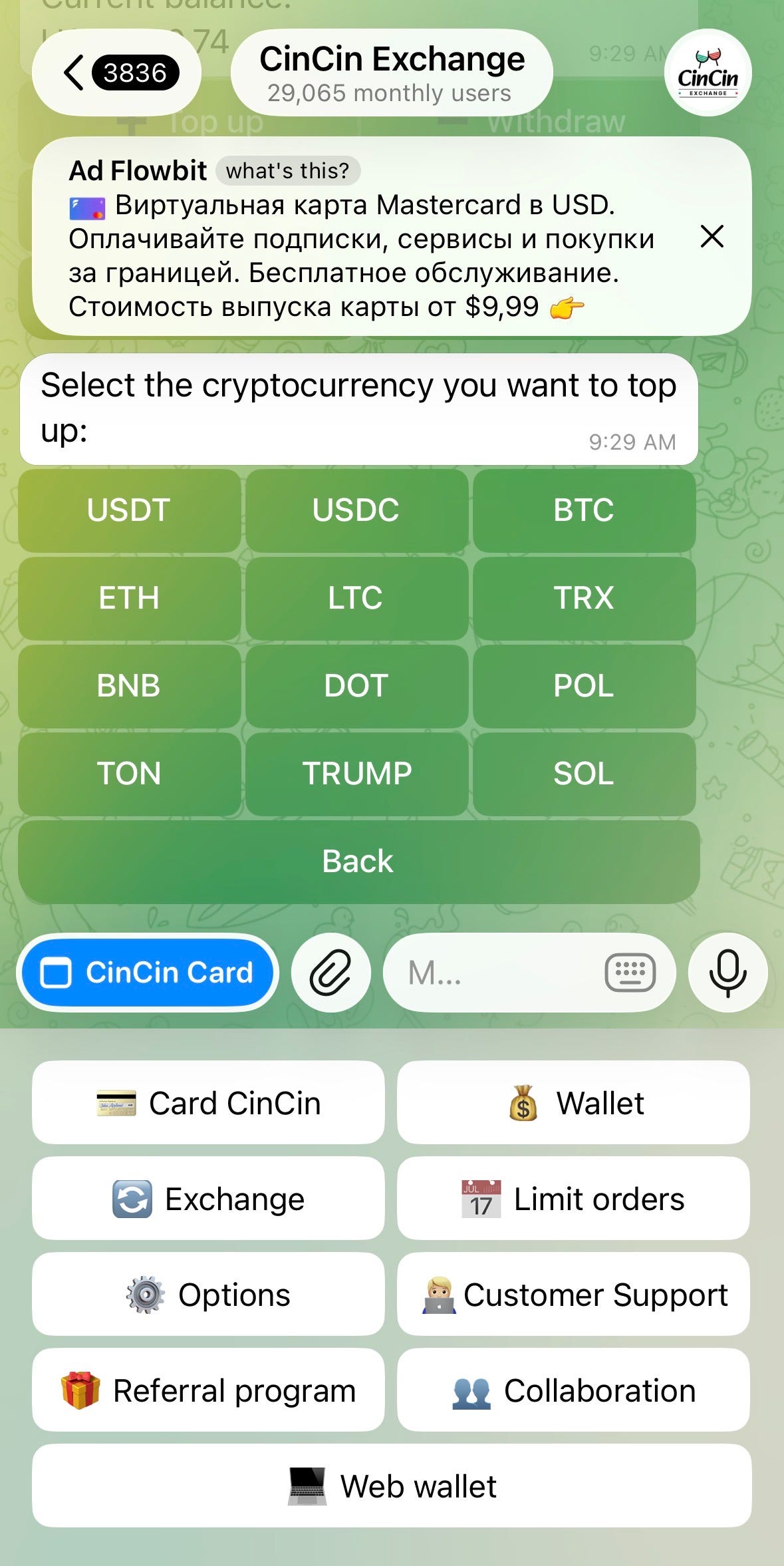
Users can choose from cards issued on BINs targeted for use in making payments for digital ads (Google Ads, Meta, etc.), making game-related payments for services like Playstation, Steam, and Epic Games, making general online payments, and for use via Apple Pay or Google Pay, including for in-person transactions.
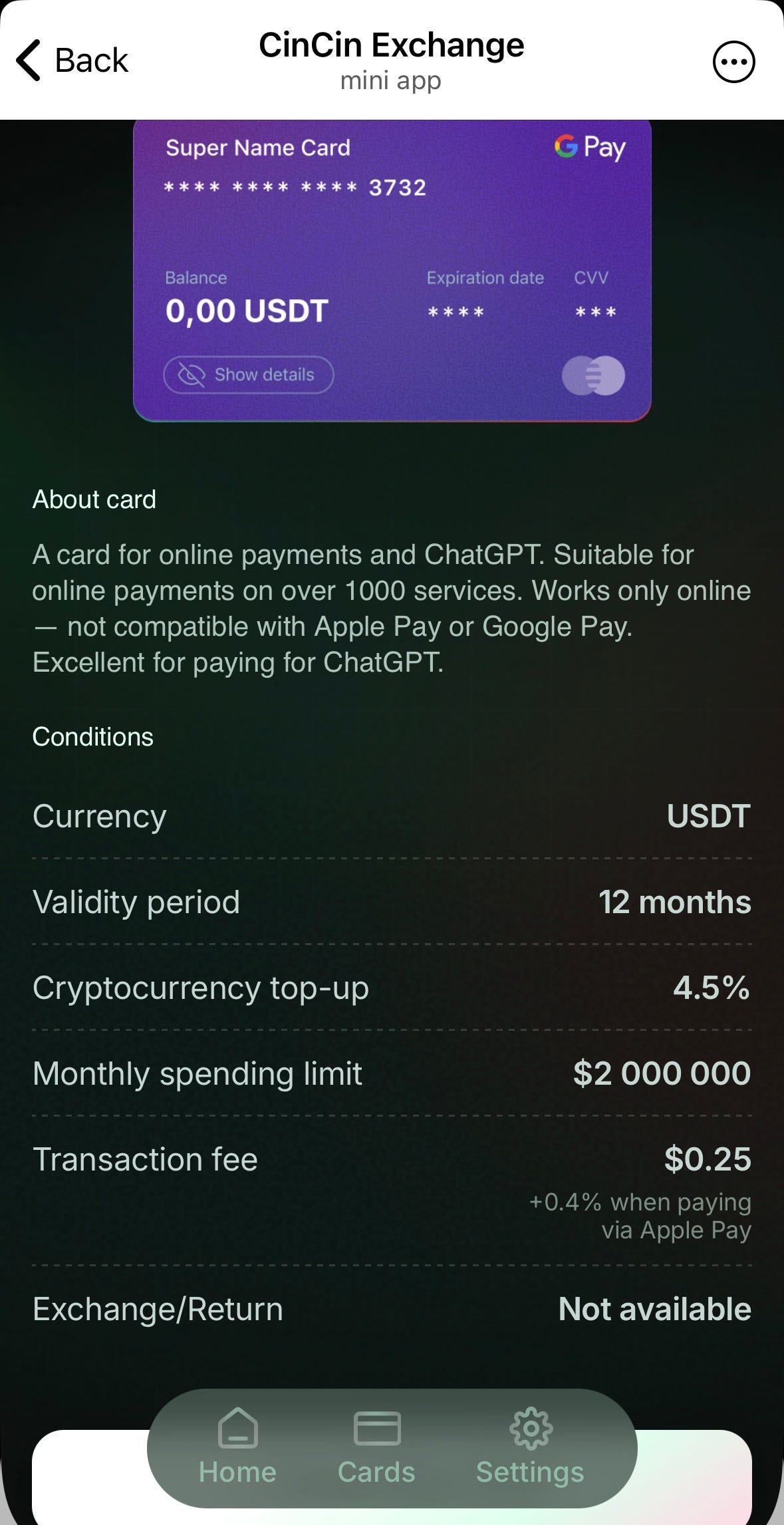
Exact capabilities and costs vary by BIN. For example, a BIN described as being for “ChatGPT / Online Card” carries a setup fee that includes $25 USDT for card issuance and a $2.25 “network” fee, a 4.5% commission on cryptocurrency top-ups, and a per transaction fee of $0.25 (plus 0.4% when paying via Apple Pay).
Users are permitted to spend as much as $2,000,000 per card per month.
There are obviously legitimate use cases for making card payments at these kinds of vendors, but online advertising spend and gaming platforms can also serve as mechanisms to attempt to clean or disguise the source of illicit funds.
Test transactions run on cards from two of the BINs offered show both were issued by Singapore-based Sunrate: one via its Hong King-licensed entity, and the other via Sunrate’s U.K.-licensed entity.
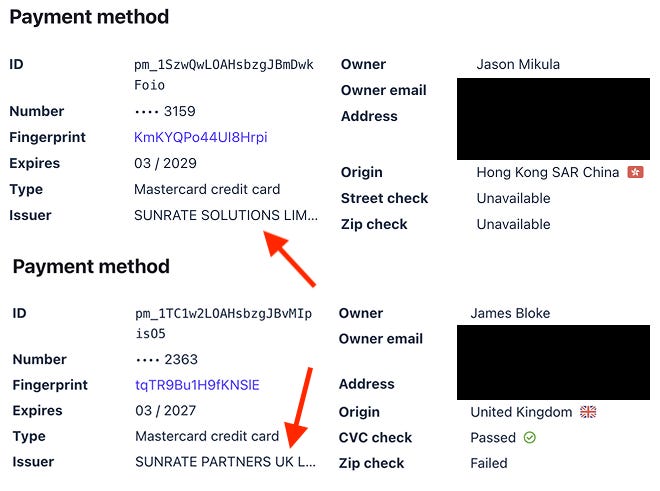
CinCin isn’t the first “no KYC” crypto card tied to Sunrate. A Fintech Business Weekly review of no KYC card providers earlier this year found cards issued by Sunrate tied to PayWithUs, ekame, nokyc.card, and UnCash.
Sunrate offers a banking-as-a-service-like global treasury management and payments platform, including programmatic corporate card issuing capabilities. The company is backed by investors like SoftBank, Redpoint China, China Growth Capital, and Aramco Ventures, the investing arm of the Saudi state oil company.
Sunrate holds a variety of types of licenses across numerous jurisdictions, including a major payment institution license in Singapore, a payments business license in mainland China, a money services operator in Hong Kong, and an e-money institution license in the U.K. The company’s U.S. entity is also registered as a money services business with FinCEN.
A representative for Sunrate did not respond to questions and a request for comment sent Friday morning, U.S. time.
CinCin Leverages Known Bluebanc/Sutton Loophole
Sunrate isn’t the only institution CinCin is using to issue cards.
Its “Game Card,” described as intended for use on game platform accounts in the U.S. specifically, is a corporate card issued by Sutton Bank via its relationship with program manager Bluebanc — the same avenue exploited by fellow “no KYC” crypto card provider PayWithUs, which Fintech Business Weekly publicly reported on in early February.
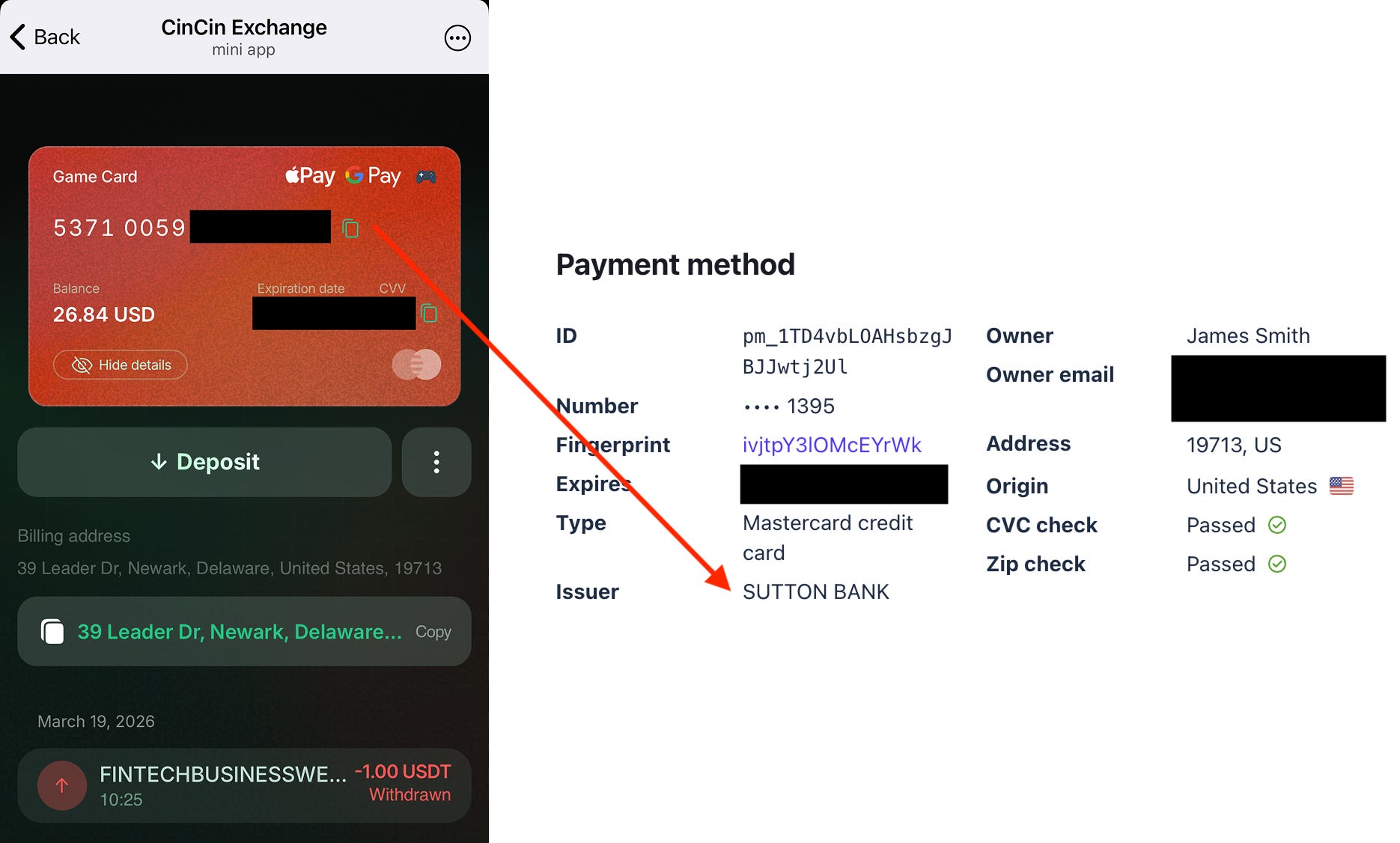
In February, Fintech Business Weekly explained:
Corporate card programs offer an easy-to-exploit loophole, in that, once the company entity has been onboarded to a program, cards can be created for individual employees, contractors, and so forth — typically without any additional verification of those individuals’ information or that they have a bona fide relationship with the company.
The challenges of policing this gaping loophole are amplified by the nested structures common in bank sponsorship, issuer-processor, and program management relationships.
Responsibility for BSA/AML compliance is often passed down a chain of partners, with collection of necessary information typically resting with the user-facing entity. But, all too often, the data doesn’t flow back up to the regulated entity — the bank — standing behind a given card program, blinding financial institutions to the true risks hidden beneath multiple layers of service providers.
The “Nth party” risk management issues posed by these relationships should already be well known and well understood after the 2022-2024 wave of consent orders focused on BSA/AML and third-party risk management failures in bank-fintech partnerships.
Sutton itself has been operating under a consent order it entered into with the FDIC in February 2024, stemming from a variety of issues, including the bank’s BSA/AML compliance and third-party risk management.
Despite entering into that consent order more than two years ago and being made aware of ongoing weaknesses in its controls in February, if not earlier, CinCin’s “no KYC” cards, issued by Sutton, were available and working as of mid-day Friday. (By mid-day Saturday, following inquiries to Sutton and Bluebanc, the card no longer worked.)
Asked about CinCin, a spokesperson for Sutton said that the bank is “undergoing a full remediation with BlueBanc, and review of all corporate expense programs to ensure appropriate oversight and operation of all downstream programs.”
The spokesperson added that “[Sutton has] no tolerance for any variant of ‘no KYC’ programs. Any program that isn’t operating appropriately will be shut down immediately.”
A spokesperson for Bluebanc emphasized it has no relationship with CinCin and said that the cards that appeared on the service “appear to have been illicitly obtained through a third party and then redistributed via unauthorized channels.”
The Bluebanc spokesperson added that the company is working to tighten its controls, including by engaging an external consultant, improving its application and card creation process, and implementing new KYB/KYC data sources.
Representatives for Mastercard did not respond to questions and requests for comment for this story.
This newsletter is made possible thanks to the generous support of paying subscribers. In addition to supporting independent analysis of the banking, fintech, and crypto spaces, paying subscribers get an extended version of this newsletter and access to full archives of past issues (5+ years of newsletter goodness!)
You can support Fintech Business Weekly by upgrading to a paid subscription, or reach more than 90,000+ loyal readers by sponsoring a newsletter.
New York Legislature Introduces Financial Data Rights Bill
Last week, New York legislators in both the state assembly and senate introduced a bill that would require covered financial institutions to make consumers’ and small business’ financial data available in secure, machine-readable electronic format at no cost, including to an “authorized representative” acting on their behalf.
The measure seeks to avoid some of the challenges the Consumer Financial Protection Burea’s 1033 open banking rulemaking has faced by spelling out, in the bill itself, that consumers may employ third-parties — like data aggregators Plaid and MX — to act as their “authorized representative.”
The bill defines this term broadly as meaning “any person or entity, other than the financial institution holding the data, that seeks to access covered data with the consumer’s or small business’s consent pursuant to section eight hundred three of this article.”
The bill imposes specific requirements on “authorized representatives,” including that they:
obtain express, informed consent in order to access data on behalf of a consumer or small business;
provide a simple, transparent mechanism for users to view and revoke data sharing authorizations at any time;
must limit their collection, use, and retention of covered data to what is reasonably necessary to provide users’ requested product or service; and
must maintain an information security program that satisfies the requirements of the Gramm-Leach-Bliley Act.
The text of the bill also explicitly prohibits fees, arguably the biggest point of contention in the CFPB open banking rulemaking. Section 1033 of Dodd-Frank, which created a consumer right of data access, didn’t speak to the permissibility of data providers charging fees one way or the other.
When the CFPB formulated the bulk of its rule implementing this right during then-Director Chopra’s tenure, it sought to prohibit banks from charging fees for data access.
The lawsuit filed by bank industry trade groups the same day the CFPB’s final rule was released, in October 2024, sought to challenge the rule’s prohibition on fees. Since then, the facts on the ground have shifted, with JPMorgan Chase pressuring aggregators like Plaid to pay for access to consumers’ data — and Plaid agreeing to do so.
The New York bill seeks to cast a wide net by defining what financial institutions would be required to share consumer and small business data broadly.
The bill would cover “banking organizations” in the state, defined in state law as “all banks, trust companies, private bankers, savings banks, safe deposit companies, savings and loan associations, credit unions and investment companies,” as well as “out-of-state banks” that serve New York residents, which state law defines to include out-of-state state-chartered and nationally chartered banks and federal savings associations.
For good measure, the bill also specifies that it would apply to “any person or entity acting as a custodian for financial assets” and “any other data provider regulated by the department that maintains a financial product or service for a resident” of New York.
The upshot is that the proposed New York bill’s legislative language seeks to cover as many categories of financial institutions and banks as possible, regardless of where the entity is based or chartered, if it is providing products and services to a New York resident.
Categories of data that covered financial institutions must make available include:
transaction information, including amounts, dates, payment types, pending or authorized status, and payee or merchant names, for at least twenty-four months preceding the request;
account balance information;
information to initiate payment to or from a covered account, including account numbers;
terms and conditions of the consumer or small business, financial product or service, including interest rates, credit limits, overdraft coverage, rewards, and fee schedules;
upcoming bill information, including amounts and due dates; and
account and identity verification information, including name, address, and contact information.
The Financial Technology Association, an industry trade group that has sought to defend the Chopra-era CFPB rule, was quick to applaud New York’s move.
FTA president and CEO Penny Lee commented on the New York bill in a press release, saying, “Americans have a foundational right to securely access and share their financial data with the apps and services of their choice – without paying a fee. Secure, fee-free data portability is the lynch pin not only of a flourishing financial ecosystem but also of future innovations that will benefit consumers.”
Still, New York’s effort is likely to face something of an uphill battle. First, it must wind its way through the legislative process and, if successful, be signed by the governor. Should the bill become law, it would almost certainly face legal challenges from financial services entities that would be covered under the measure.
Everything Else: Lineage Completes Recap, BlockFill Goes Bankrupt, Mastercard Buys BVNK
Last week, Lineage Financial Network, the bank holding company that owns Lineage Bank, announced that it has completed the sale of a majority stake to Recap Financial Ventures.
Recap Financial Ventures, which saw its application to become a bank holding company approved by the Fed last month, raised $30 million from local Tennessee investors, according to its press release, of which $15 million was used to purchase preferred stock in Lineage. The transaction provided an immediate capital infusion to the bank that has struggled in the wake of the collapse of its one-time banking-as-a-service partner, Synapse.