

Hey all, Jason here.
Have enjoyed my first full week here in Mexico City. Looking forward to catching up with folks in town for various fintech-related events this week. I’ll also be hosting a virtual discussion later this week with Trisha Kothari (Unit21) and Natasha Vernier (Cable) on managing compliance in layered fintech relationships — more info and register here.
Introducing Modern Treasury Payments, Built to Move Money Across Fiat and Stablecoins
Sponsored Content: This week, Modern Treasury launched Payments, a new integrated payment service provider (PSP).
Here’s why every startup or enterprise that moves money should be paying attention:
With one API, you can orchestrate payments across ACH, wire, RTP/FedNow, push-to-card, and stablecoins. Instead of stitching together bank relationships and new rails as they emerge, you get a single, developer-first integration that simplifies—and future-proofs—your payments stack.
Go live in days, not 6–12 months. Modern Treasury manages the bank relationships and includes KYC/KYB, customer accounts, transaction monitoring, fraud checks, and reconciliation out of the box. That means less time managing infrastructure and operations and more time focused on your core product.
Under the hood, Payments runs on Modern Treasury’s industry-leading Ledgers, giving you a unified system of record with real-time visibility and built-in accounting guarantees. This foundation has already powered $400B+ in payments across a deep roster of customers.

After Missed Coupon Payments, Evolve Creditors Look To Dump Embattled Bank’s Distressed Debt
New regulatory filings reveal that Evolve Bank & Trust’s bank holding company, Evolve Bancorp, had zero operating income in 2025.
This isn’t a surprise, as, historically, the holding company’s income has primarily come from dividends upstreamed from the bank.
With the bank posting an overall loss of about $3 million in 2025, it makes sense the bank wouldn’t erode its equity positioning by paying out dividends.
Even if it had wanted to, doing so would have required the approval of its primary federal regulator, the St. Louis Federal Reserve, per the terms of the wide-reaching consent order the embattled bank continues to operate under.
Evolve Bancorp posted a net loss of about $7.4 million in 2025, according to its recently filed FR Y-9SP form. As Fintech Business Weekly pointed out in May 2025, the holding company is functionally insolvent.
The holding company’s lack of any income poses a major problem: keeping current on its coupon payments to debt holders.
Evolve Bancorp reports a total of $51.1 million in outstanding long-term borrowings as of the end of 2025.
And, Fintech Business Weekly is the first to report, it has missed coupon payments on at least some of those outstanding notes, according to offering information tied to the prospective resale of Evolve notes with a face value of $10 million.
The holding company’s regulatory filings also indicate it has a liability of $5,791,000 of interest due on its subordinated debt:

Correspondence reviewed by Fintech Business Weekly indicates that investment bank Stifel is soliciting bids on the two tranches of notes: $5 million, paying a 4% coupon with a maturity date of April 2031, and another $5 million, paying a 4.5% coupon, with a maturity date of April 2032.
Stifel notes that the debt is unrated and that “[t]he company has missed its most recent coupon payments, indicating credit distress.”
The asking price is 40.00 ($0.40 on the dollar), indicating a potential transaction at a significantly distressed price.
As part of the offering, Stifel prepared an overview of the holding company and its bank subsidiary’s financial position, including simplistic models of how potential financial liabilities related to the Synapse disaster could impact the bank’s financial condition.
The report highlights the $46 million allocation the Consumer Financial Protection Bureau made towards reimbursing victims of the Synapse-Evolve disaster, noting that the government bailout could functionally reduce Evolve’s liability (spacing adjusted and emphasis added):
“On December 22, 2025, the Consumer Financial Protection Bureau announced it had allocated $46.2 million from its Civil Penalty Fund in order to reimburse individuals impacted by the failure of Synapse. For perspective, this compares to missing funds estimated to be in the $60 million - $95 million range.
This development in late 4Q25 was of material importance to [Evolve] in that we think it could (and we stress the speculative nature of the word) represent a reduction in any net liability poised to [Evolve] from the Synapse bankruptcy.
The Stifel report also includes a simplistic capital burn down and liquidity coverage analysis, under scenarios where Evolve faces “low” ($30.7 million), “mid” ($50.7 million), and “high” ($75.7 million) combined liabilities stemming from the bank’s 2024 hack by a Russian cyberransom group, the shortfall in Synapse funds (net of the CFPB bailout), and potential regulatory fines.
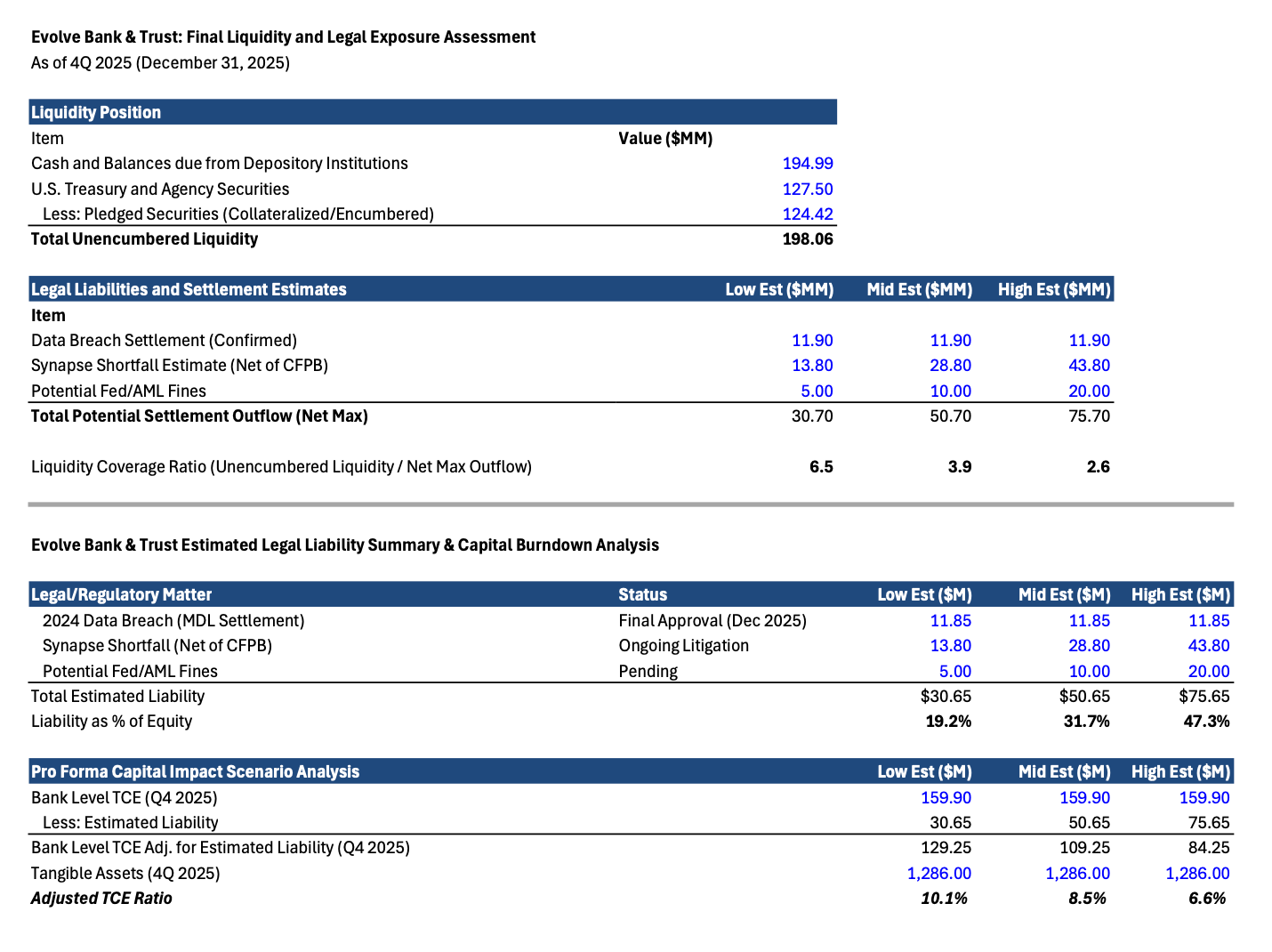
Even in the worst case scenario, Stifel projects Evolve Bank would maintain a 6.6% adjusted tangible common equity ratio. TCE ratios are more commonly used as a market metric, and there is not a specifically prescribed regulatory minimum for this metric. Industry analysts generally consider a 5% or higher TCE ratio as a rough benchmark of capital adequacy.
Evolve’s Net Loss For 2025 Narrowed to About $3 Million
Despite the negative news related to its holding company’s debt, Evolve Bank’s financial picture improved somewhat, per its 2025 end of year call report.
Income and expense data on bank call reports are reported on a year to date basis, which creates some noise in the specific numbers quarter to quarter.
For example, as of the end of Q3 2025, Evolve had reported net income of -$14 million. But, by the end of the year, the bank’s net loss had shrunk to a considerably smaller -$3 million.
A major driver of the improvement in the bank’s Q4 financial performance was substantially lower (technically, negative) legal, consulting, and advisory fees. Evolve also saw somewhat improved net interest income in Q4, up about 7.6% or $743,000 vs. Q3 2025.
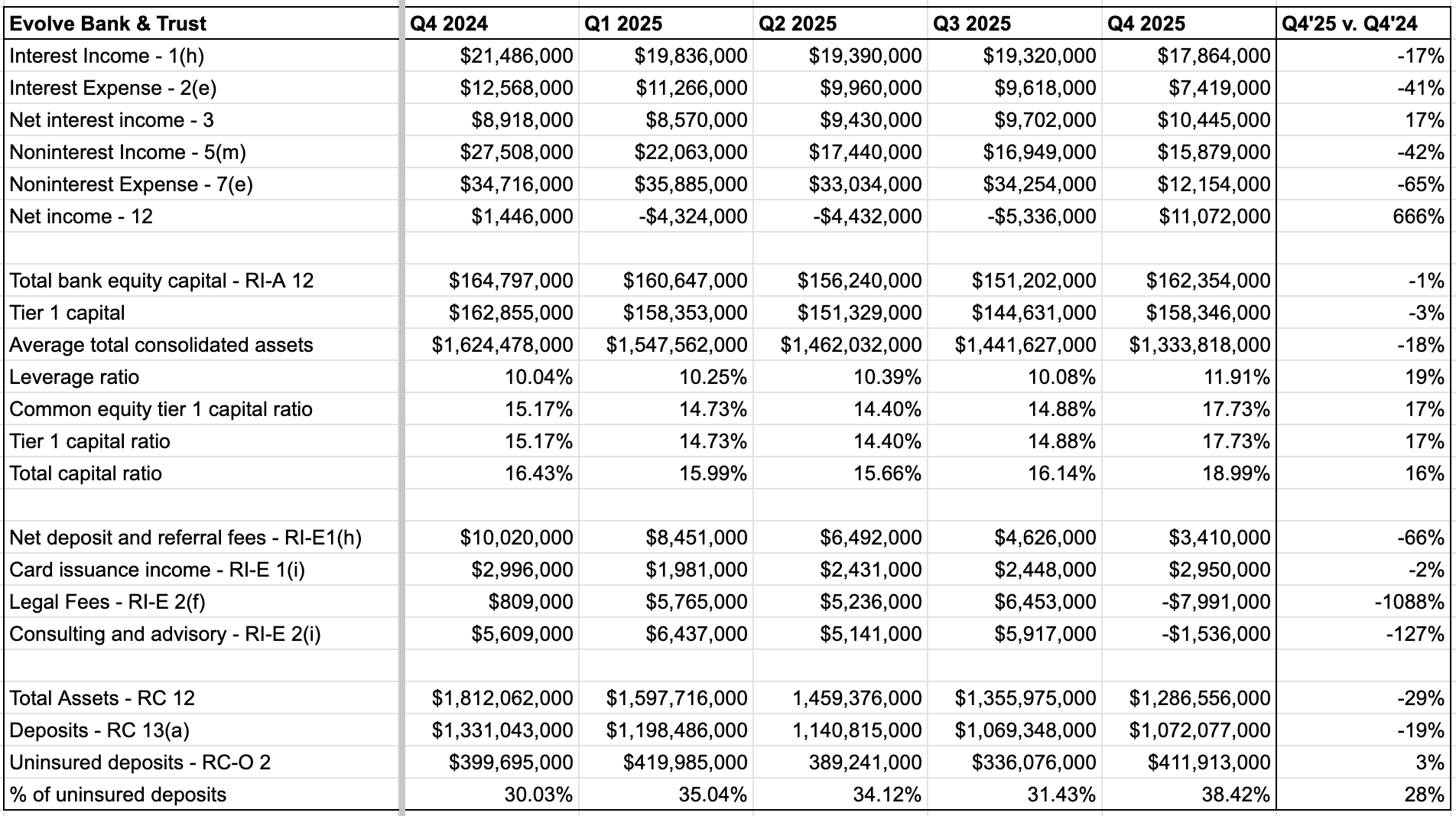
Evolve is feeling the impact of fintech programs fleeing the bank: it has seen on balance sheet deposits decline by nearly 20% vs. Q4 2024. Whether or not partners still working with Evolve, which include teen banking startup Step (just acquired by YouTuber MrBeast), cash advance app B9, and middleware platform Mbanq, will continue to do so is an open question.
Revenue from deposit and referral fees has plunged by 66%, owing both to the departure of major fintech programs, like Mercury and Dave, as well as declining interest rates, which makes deposit placement less profitable.
Evolve has also seen its share of uninsured deposits increase. Nearly $412 million, or about 38% of Evolve’s on balance sheet deposits, are uninsured — representing a potential run risk, should those depositors grow concerned about the bank’s financial position.
But, to be sure, Evolve currently remains well-capitalized by traditional metrics, with a 11.91% leverage ratio and a 17.73% CET1 capital ratio.
There is another notable new item appearing in Evolve’s Q4 call report: a $26,153,000 liability that the bank describes as an “Open Banking Division Reserve.”
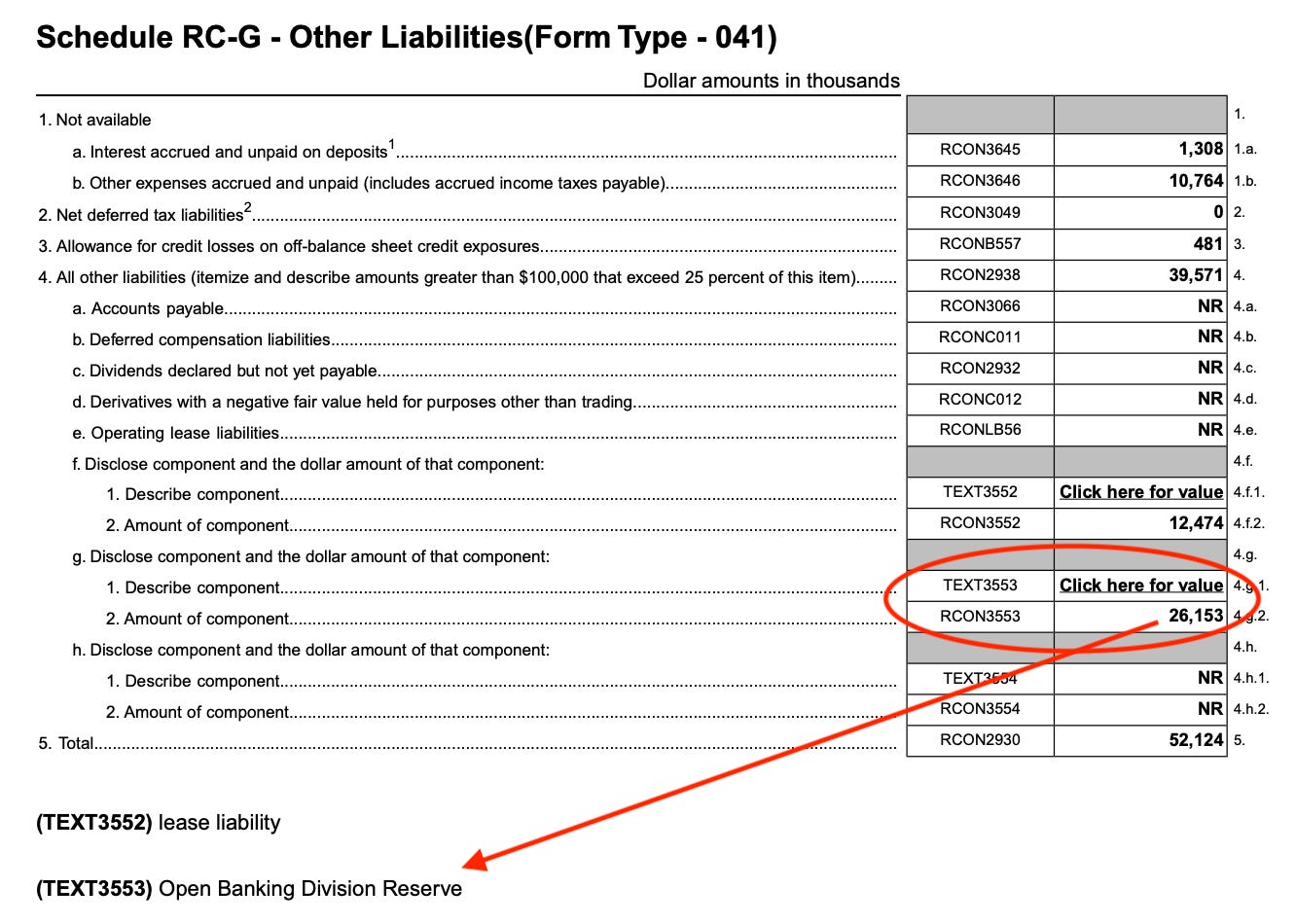
It’s not clear exactly what this reserve is held for, but possibilities include additional payments owed to end user depositors, other contingent liabilities related to Evolve’s role in the Synapse disaster, and the multiple outstanding civil cases stemming from the situation.
A representative for Evolve Bank & Trust did not respond to questions or a request for comment for this story.
This newsletter is made possible thanks to the generous support of paying subscribers. In addition to supporting independent analysis of the banking, fintech, and crypto spaces, paying subscribers get an extended version of this newsletter and access to full archives of past issues (5+ years of newsletter goodness!)
You can support Fintech Business Weekly by upgrading to a paid subscription, or reach more than 90,000+ loyal readers by sponsoring a newsletter.
Bridge, Seeking Trust Bank Charter, Derisks
Bridge, the stablecoin “infrastructure” company Stripe acquired for $1.1 billion, received conditional approval last week from the Office of the Comptroller of the Currency on its application to charter a national trust bank.
Bridge’s application, filed in October 2025, describes Bridge as “a platform that can offer the technology needed to adopt fiat currency-denominated stablecoins, including conversion from/to corresponding fiat currency, in ordinary commerce (e.g., supply chain, payroll, vendor payments, goods and services purchases) where stablecoins provided payment service providers and their end-users with a faster, cost-efficient, and more secure method of facilitating payments.”
Per its charter application, the company’s proposed Bridge National Trust Bank will “conduct activities that complement and enhance existing business lines, including custody, stablecoin issuance, management of stablecoin reserves, and related fiduciary services.”
The company’s application also emphasizes its belief that stablecoins offer a “faster and cheaper access than traditional alternatives” for cross-border payments and “give[] more true economic choice to customers globally, enabling them to easily save and spend U.S. dollars.”
The charter application is hardly Bridge’s and parent company Stripe’s only mention how stablecoins can make it more “efficient” to access US dollars for users who would typically have difficulty doing so.

In a November 2025 episode of Stripe’s “Cheeky Pint” podcast, Stripe cofounder and President John Collison was joined by Bridge cofounder Zach Abrahms and Henri Stern, co-founder of the wallet-as-a-service company Privy, which was acquired by Stripe in June 2025. (The original version of this post incorrectly identified the podcast as being hosted by cofounder and CEO John Collison; we sincerely regret the error.)
During the lengthy conversation that served as something of an infomercial for Stripe, Bridge, and Privy, the trio extolled the benefits of stablecoins, including Tether.
The conversation included repeated references to stablecoin use cases, such as facilitating cross-border payments in places like Rwanda and trading between USD-denominated stablecoins and foreign currencies, specifically using the Venezuelan bolívar and Colombian peso as examples.
The discussion did not include, however, any mention of how stablecoin infrastructure providers like Bridge, which facilitates movement between local fiat currencies and USD-pegged stablecoins, comply with applicable financial crime regulations or work to detect and mitigate financial crime risks, such as money laundering, terrorist financing, and sanctions evasion.
The companies’ seemingly cavalier attitude towards these risks came home to roost in the form of Stripe and Bridge client Kontigo, a Venezuelan crypto app which facilitated evasion of U.S. sanctions on the country and is rumored to have ties to the son of deposed dictator Nicolas Maduro, as first reported by Fintech Business Weekly in early January.
The companies’ risk appetite appears to have shifted since then, however.
A comparison of the list of countries Bridge says it supports today vs. an archived version of the same list from December 2025 shows that Bridge no longer facilitates services for some extremely high-risk jurisdictions it previously supported in limited capacities — including Russia, Belarus, Lebanon, Libya, Somalia, and South Sudan.
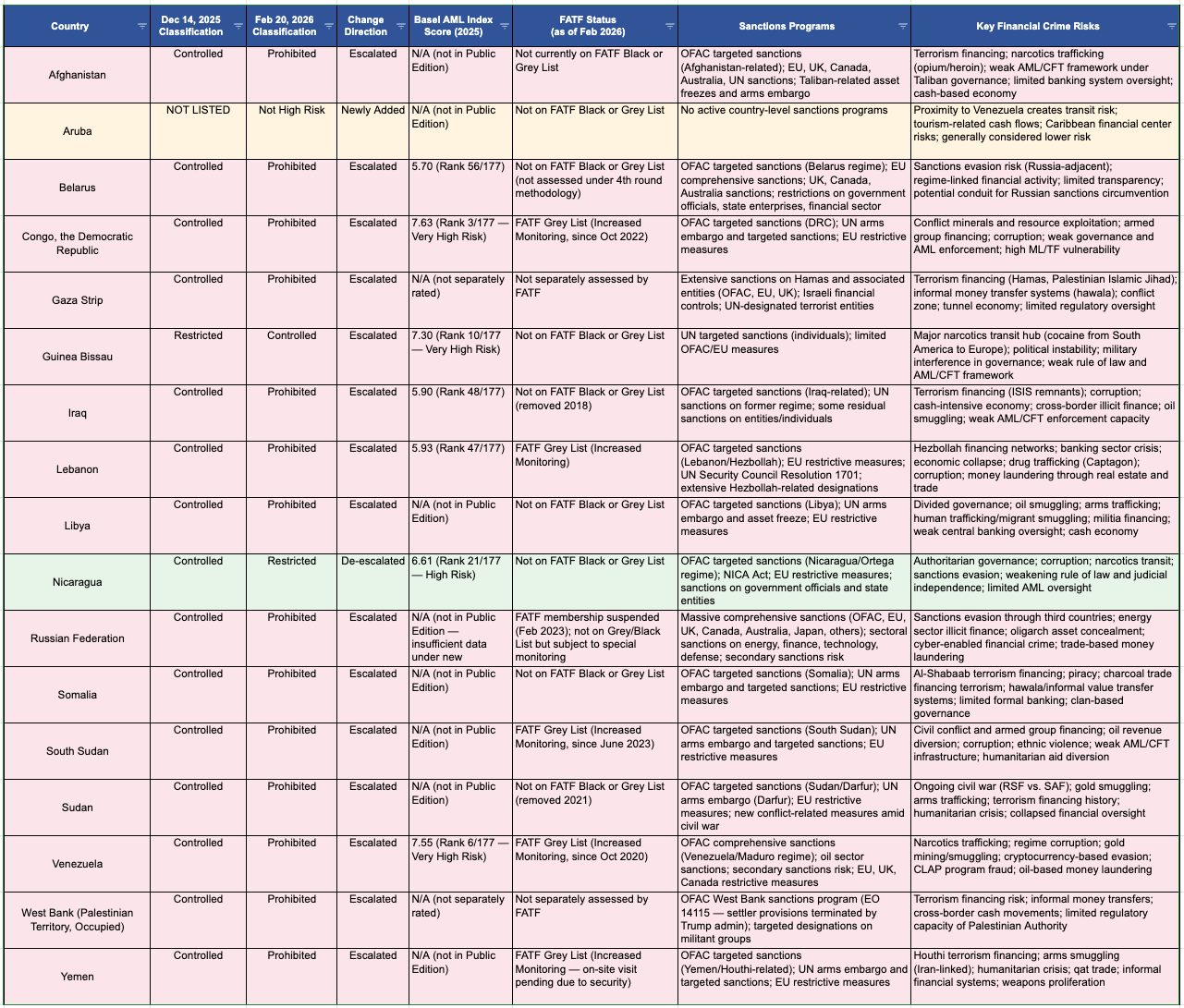
According to Bridge’s documentation, in “controlled” jurisdictions, the company “will not facilitate services for these jurisdictions, except for specially approved programs,” while in “restricted” jurisdictions, Bridge “will facilitate services for these jurisdictions, with additional monitoring and controls.”
Bridge will not facilitate services in “prohibited” jurisdictions, “except in extraordinary situations.” The company does not define what, exactly, would constitute an “extraordinary situation.”
Asked about the change in risk classifications, a spokesperson for Stripe and Bridge explained that Bridge is, on a continuous basis, evaluating its policies to make sure they are in line with the company’s risk tolerance and compliance obligations.
The spokesperson added that, over the last several months, it has updated its polices regarding support for certain geographies and jurisdictions.
Everything Else: Upstart’s Revolving Credit Product, Payoneer Adds Stablecoins with Bridge Integration, American Lending Fairness Act, Robinhood Plans IPO for Its Venture Fund (Paying Subscribers Only)
Also last week, Upstart announced a small-dollar revolving credit product, Payoneer added support for stablecoin rails, Robinhood announced plans to take its venture fund public, and, earlier this month, the American Lending Fairness Act was introduced in Congress.